Cape May Warbler by Avery Whitlock
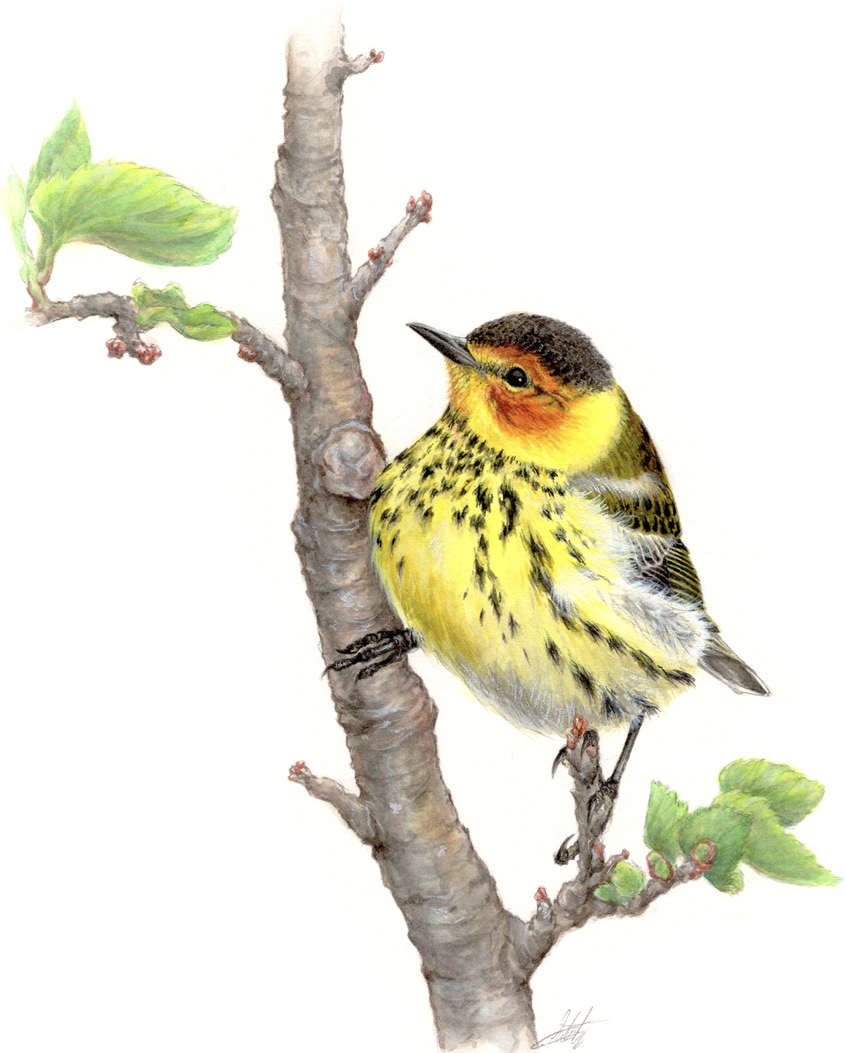
Cape May Warbler by Avery Whitlock
Many birds, for example Black-and-white Warbler, are well named. Many are not, and the Cape May Warbler is arguably among them. The species was first discovered and collected by George Ord in May 1809 and subsequently described by Alexander Wilson in 1812 (Stone 1937). Guess where Ord discovered and collected it? Yep, Cape May, New Jersey. Cape May Warblers neither nest nor winter in Cape May and are relatively uncommon during migration. Witmer Stone considered it a red-letter day when he came upon a Cape May Warbler in Cape May.
The species nests in northern boreal forests mostly in central and eastern Canada and winters in the West Indies and Florida and sparingly in Costa Rica. None of these places is near Cape May, New Jersey. However, the scientific name of Cape May Warbler, originally Sylvia maritima, then Dendroica tigrina, and now Setophaga tigrina, does have some descriptive accuracy. The species name tigrina refers to the distinct breast streaking, thin black tiger streaks on a yellow breast, most evident in spring-plumaged males.
To view the rest of the article you'll need to
subscribe. Bird Observer publishes original articles on birding locations, on avian populations and natural history, on regional rarities, field notes, field records, photographs, and art work.