 In 1851, Henry David Thoreau took a long walk west of Concord with a friend, the poet Ellery Channing. “Soon got into a country new to us,” Thoreau wrote in his journal. “In Wayland opposite Pelham or Heard Pond, going across … cedar hills and valleys near the river … and great old chestnuts, the largest collection of chestnut trees which I remember to have seen.”
The “country” he was describing is a portion of the former Paine Estate in Wayland. Before Thoreau and before the Paines, before the Greens who came before the Paines and the Shaws who came before them, before any of the Puritan settlers arrived in 1638, this landscape was shared by the Agawam, Massachusett, Nipmuc, Pawtucket, Wampanoag, and Susquehanna tribes. For thousands of years, these tribes used the land for seasonal hunting, fishing, and foraging. As has been the case with much of Massachusetts, Indigenous people were pushed out and decimated by smallpox and measles. Eventually, whole Indigenous communities were removed, confined, or killed in conflict.
The impact the early colonists had on this region also included large-scale land clearing for farming. Stone walls mark the borders of their farms. The farmers produced grains, hay, and vegetables, and created pasture for livestock. (Wayland Historical Society) Native grasses and plants were overrun by varieties preferred by Europeans. Riverside meadows were burned and turned into fields. The river’s fish were harvested for food and fertilizer. By 1800, much of Wayland’s low-lying fields along the river were turned into croplands and hayfields, while tree harvesting continued in the hilly uplands. The massive freshwater wetlands and floodplains, all once part of the Great Meadow, were much reduced. As farming eventually declined in favor of industry, some of the floodplain and woodland recovered, but much of the damage lingers.
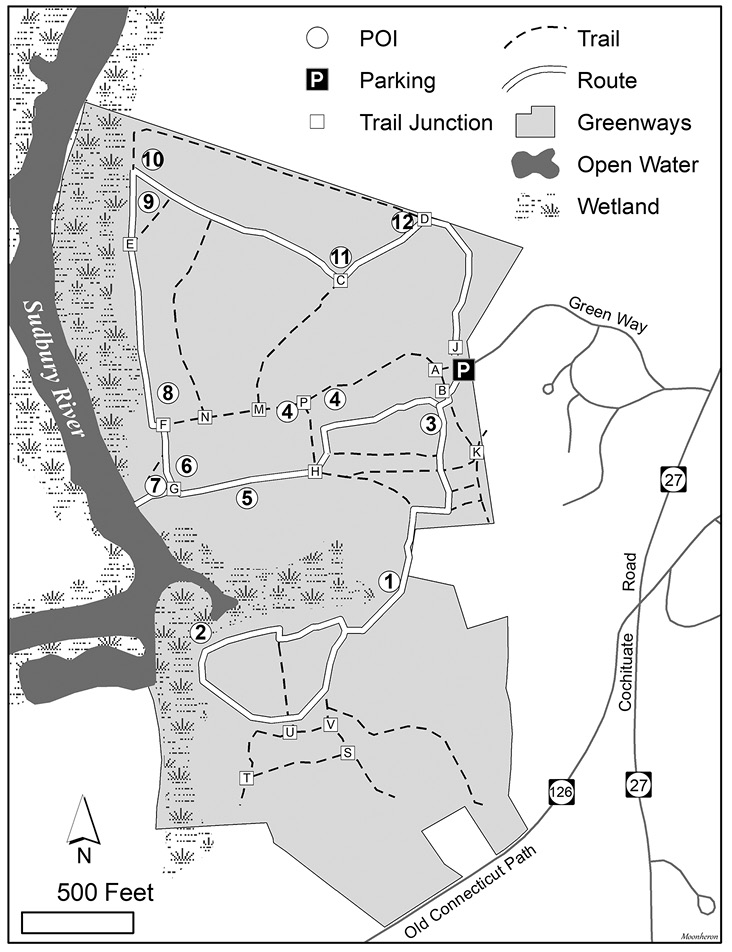
Map of Greenways Conservation Area.
To view the rest of the article you'll need to
subscribe. Bird Observer publishes original articles on birding locations, on avian populations and natural history, on regional rarities, field notes, field records, photographs, and art work.