Jeffrey Ritterson
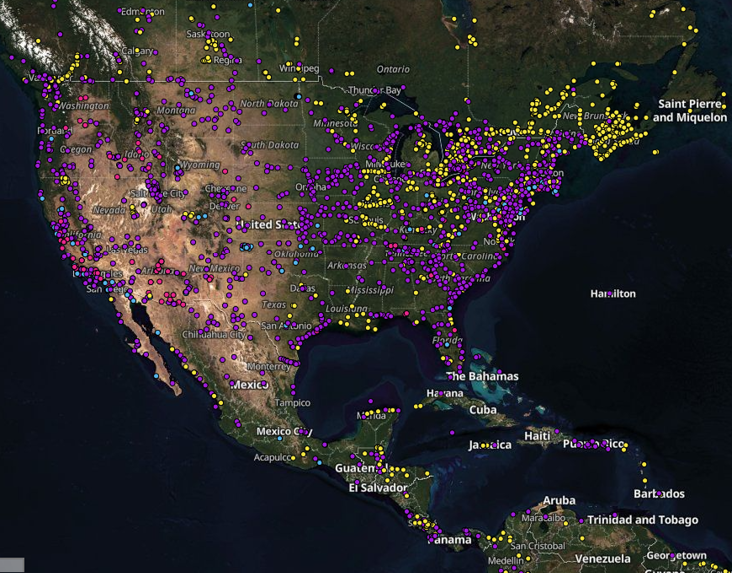
Figure 1. The distribution of Motus stations from southern Canada to northern South America is represented by the dots. Dot colors reflect different station configurations, the explanation of which is beyond the scope of this article. Screenshot from www.motus.org.
To be a human on this planet is to observe birds. Our avian companions are so conspicuous and widespread that you would have to be living with your head in the sand to not notice them. Whether intentionally or not, we are all bird observers. With even the slightest interest in birds, it is only natural to wonder: where do they go? It is commonplace to lose track of a bird, only to have it appear minutes or hours later. Many species seemingly vanish for half of the year. We are not nearly as naïve as we once were, and our understanding of bird migration, as well as local and regional movements, is rapidly growing due in large part to technology.
In her 2023 book Flight Paths, Rebecca Heisman provides a thorough account of early human explanations of bird migration, from indigenous perspectives to hypotheses put forth by Aristotle and others, i.e., that swallows hibernate in rock crevasses, or on lake bottoms, or perhaps migrate to the moon. A series of early anecdotes supported the notion that birds move across large distances, but it was not until the turn of the twentieth century that the movement of birds began to be studied systematically with the development of numbered leg bands.
To view the rest of the article you'll need to
subscribe. Bird Observer publishes original articles on birding locations, on avian populations and natural history, on regional rarities, field notes, field records, photographs, and art work.