Mark Lynch
Birds Up Close: An Engineer Explores Their Hidden Wonders.
Lorna Gibson. 2026. Cambridge, Massachusetts: MIT Press.
Birds. The Goldfinch, Birds, Art and Us
Simon Schama and Martine Gosselink. 2026. The Hague, Netherlands: The Mauritshuis/Hannibal Books.
Here are two new books that present two unique views of birds. In one, you will find a very deep dive into the physics of birds and, in the other, a multimedia meditation on what birds mean to humans.
 “Birds are amazing.” (p. ix Birds Up Close)
Who would have thought that a hummingbird draws nectar into its mouth using a pump action created by the interplay between the surface tension of the nectar and the springiness of the fringes on its tongue? A wonderful discovery. (p. 113 Birds Up Close)
Have you ever watched a chickadee in deep winter and wondered how that little ball of fluff is staying warm? Looking at the brilliant deep blue of a male indigo bunting, have you considered where that color comes from? One of the most common bird questions is, of course, how do woodpeckers escape fatal brain damage? All of those questions, and many more, are answered in the brilliant new book Birds Up Close by Lorna Gibson.
Lorna Gibson is the Matoula S. Salapatas Professor of Materials Science and Engineering and a MacVicar Faculty Fellow at MIT. She grew up in Britain, where family trips to places including the Niagara Escarpment and the Farne Islands, gave her a real passion for nature. She became a classic science nerd at an early age. Her focus of graduate research was “the mechanical properties of materials with a porous, cellular structure like honeycombs and foams.” (p. xviii) This remains her special field of interest to this day. She moved to Massachusetts in 1984 and took a faculty position at MIT. This background sounds like it would make her just about the last person who would write a fascinating book about birds. But she came across that question about how woodpeckers don’t injure their skulls and brains despite battering hard wood with their bills.
With all this pecking, how do woodpeckers avoid brain injury? For a long time, people thought that woodpeckers had a special, foam-like material between their brains and their skulls, a little like the padding in a bicycle helmet. Because the mechanics of foams is my research specialty, when I heard about this, I had to find out more. I discovered that in the 1970s a group of neurologists interested in human brain injury had dissected the head of a pale-billed woodpecker—only to find that there was no special foamy material protecting the brain. (p. 104)
She consulted colleagues, did some thorough research, and produced a paper. From that serendipitous beginning, she decided to write a more extensive book on the materials science view of some of the most unique aspects of birds.
Birds Up Close is the result of her inquiries, and it is unlike any book you will have read about birds. There have been several books that give the reader a superficial understanding of how birds fly or what makes up the color of their plumage. But Birds Up Close gets down to the actual structural physics about why a Blue Jay looks blue. Though a serious science book, Birds Up Close can be enjoyed by any reader with real interest in the natural world.
Because Gibson is a seasoned lecturer and teacher, her book begins by giving an overview of the subjects she will cover in each chapter. It’s as if the reader is a student in one of her classes, and she passes out a syllabus.
Then there are bird bills: the Swiss Army knives of the bird world, used for everything from feeding to preening to nest-building. Bird bills come in diverse sizes and shapes, and are matched to what each species eats. (p. x)
Bird eggs, of course, are marvels of nature. Their shells are at once strong enough to protect the embryo and weak enough for chicks to break through when they’re ready to hatch. (p. xi)
Beyond all that, birds fly! What else is there to say? Bird flight is one of the wonders of the natural world. Some, like mallards, flap their wings furiously, while others, like broad-winged hawks, soar and glide with barely any movement. (p. xiv)
There are two chapters about the form and function of feathers, and another two chapters about flight. There are single chapters devoted to bones, bills, and eggs. Each section is profusely illustrated, typically in color. Like many scientists, Gibson believes visual examples are critical to any lecture. Because the book was designed by MIT Press, the illustrations and photographs are top notch and not crowded on the page. Birds Up Close is a beautiful book.
From the beginning, the passion Gibson feels for the material is obvious. She is a birder mostly of Massachusetts, but not really a lister. She feels awe and wonder for how birds go about their lives. Local bird spots like Cape Ann, Plum Island, Forest Hills Cemetery, and Arnold Arboretum are all cited.
Each section begins with a summation of specific topics to be investigated. For the chapters on feathers, she begins with a description of the display of a male Broad-tailed Hummingbird in the Colorado Rockies. This complex behavior has both visual and auditory elements all produced by the manipulation of feathers.
How do they do it? What makes some feathers iridescent while others are not? How do feathers produce sound? And how do other feathers suppress sound, allowing owls to fly almost silently as they approach their prey? For that matter, how do the feathers on owls’ facial ruffs focus sound toward their ears, enabling them to hunt by hearing alone. (p. 2)
The amazing variety of a bird’s plumage arises due to two types of processes: some colors are due to pigments that are actually on the feathers, and other colors are caused by microscopic structural elements reacting to visible light.
The pigment palette in feathers includes black, gray, red, yellow, orange, brown and green, but not blue; there are no blue pigments in feathers. So where do the blues of blue jays, eastern bluebirds, belted kingfishers, and cerulean warblers come from? Blue, violet, and ultraviolet are structural colors, resulting from the interaction of light with microstructural features within the feather barb that are similar in size to the wavelength of light.
How does this work? (p. 12)
If you have ever seen a male Ruby-throated Hummingbird on territory perched high atop a small branch, you will have noticed that its gorget will sometimes look iridescent red but at other times will appear black. What’s going on? As you learn in Birds Up Close, iridescence, like blue, is a structural color, a product of the physical make-up of the feathers.
Iridescence, too, is a structural color. Striking displays of iridescence appear in the feathers of many hummingbirds, the scales of some butterfly wings, the outer cuticle of beetles, and a thin layer of oil on a puddle of water. One of the defining characteristics of iridescence is that apparent color changes with the angle of viewing: for instance, the throat of the ruby-throated hummingbird turns to deep olive green when viewed from the side instead of from the front. (p. 14)
That quality of iridescence is seen on some of the most common birds around us.
Similarly, the feathers of the shiny cowbird, European starling, and glossy ibis all derive their iridescence from a single well-defined layer of melanin granules beneath the outer shell of transparent keratin, resulting in bronze, purple, blue, or green, depending on the angle of viewing. The transparent outer layer of keratin in a shiny cowbird barbule has been measured to be 0.084 microns, about one thousandth the diameter of a human hair. That feathers have such tiny structures within them producing iridescence is stunning. (p. 20)
The awe that Gibson writes about experiencing when seeing a bird fly or create a noise with its feathers is contagious. Birds Up Close is a unique book describing serious science that all birders can experience every time we are in the field. Birds Up Close bridges the worlds of physics and natural history seamlessly and reveals a wide array of marvels we birders often overlook. Gibson is a passionate writer, and that makes Birds Up Close one of the best hard science books for a general reader who is not put off by diagrams and graphs. Besides, there are lots of great color photographs of birds too.
Back at Cape Ann, watching rafts of eiders, I marvel not just at their striking beauty, but also at how their life in frigid waters relies on the remarkable microscopic structures within their feathers. I marvel at the precise spacing of the barbs and barbules in their outer contour feathers that make them so water-repellent, keeping them dry. And at the flimsy-looking, microscopically branched structure of down that reduces heat loss by conduction, convection, and radiation. Their feathers are a wonder. (p. 65)
 For decades I taught classes at the Worcester Art Museum (WAM) and also trained to become a docent and lead tours there. One year, I was in the middle of giving a gallery talk about the museum’s famous collection of Antioch mosaics when I recognized a purple swamphen in one corner of the Ktisis mosaic. It was a revelation. What was a purple swamphen doing on a 2000-year-old mosaic? Why had the artist(s) cared so much that they created a recognizable image of this bird out of tiles? Why did the artist choose this species and not another? Are swamphens even found today in this part of Syria and Turkey?
This observation began a lifetime interest in looking at birds in art. I even began leading annual birders' tours of the museum’s collection. I encouraged people to bring their “bins” into the museum and even wear wellies if they liked. The great thing about art museum birding is that you can pass out a species list before the tour begins. As years passed, I birded other museums’ collections, collected many books on birds in art, and even gave lectures to teachers on how to use art museums as resources in natural history.
So, when I read that a catalogue for an exhibition on birds in art at the world famous Mauritshuis museum in the Hague, Netherlands, had been published, I was hooked. Furthermore, it was published in English, so I knew I really had to get a copy. My high expectations for the book were realized, and Birds: The Goldfinch, Birds, Art and Us is one of the best, most enjoyable books currently available on the subject.
For art museum birders—and there are a number of us—Dutch and Flemish paintings of the sixteenth and seventeenth centuries are a treasure trove for finding examples of recognizable bird species. Personally, I have found Eurasian Bitterns, Eurasian Bullfinches, and a Eurasian Green Woodpecker smaller than my pinky fingernail all in paintings of that period. This era was a period of close observation and discovery, and artists of the time put that knowledge of their visual world in their work.
The Mauritshuis is an art museum in a Dutch seventeenth-century building. Among the many gems in its collection are works by Vermeer, Rembrandt, and Steen. The Goldfinch, in the title of the book and exhibition, was painted by Carel Fabritius (1654) and is in the Mauritshuis collection. This small painting of a captive European Goldfinch chained to a small shelf is an important work of the period—novels have been written about it—and of course it is covered in the catalogue. The exhibition ran from February 12 until June 7, 2026.
The person who got this exhibition off the ground was Sir Simon Schama, historian, author, and television presenter. He is a professor at Columbia and has taught at Cambridge, Oxford, and Harvard. His specialties include art history, Dutch history, French history, and Jewish history. His book An Embarrassment of Riches changed the way I thought about the culture and art of the Dutch “Golden Age.” His essay “Oh, for the wings…” begins the catalogue of Birds. This wide-ranging survey and appreciation of birds in art and culture (p. 14-43) is some of the best writing in the entire book. Who knew that Sir Simon Schama was so passionate about birds?
As far as art is concerned, then, birds keep close company with death. Not invariably though. A counter tradition invokes them as harbingers of new life, a second life, or even life eternal. Possibly the most telling moment in the “What is art?” trial was when Jacob Epstein was asked by one of the government lawyers if Brancusi was not ‘isolated’ (meaning incomprehensibly outré) in his efforts? To this line of questioning, Epstein replied firmly: ‘no, he is related to a very ancient form of sculpture. He does not stand absolutely alone. He is related to the ancient sculptures like the early Egyptian of 3,000 years old’, and then announced that he would bring illustrations of his contention. Off he went, outside the court, to do just that. ‘This,’ Epstein said, on returning, dramatically flourishing his photograph, ‘is an ancient Egyptian hawk, 3,000 years ago.’ Startled, Justice Waite asked him if that was really for him a recognizable hawk? ‘An ornithologist might not see it…the feathers are not shown, the feet are not shown…still you get the impression it is a hawk?’ ‘Yes,’ said Epstein firmly. (p. 26 of Oh, for the wings... in Birds)
His essay touches on everything from Breughel’s birds in hell, Picasso’s passion for owls, Bjork’s swan dress, and surrealist Max Ernst’s man-bird alter ego:
Meet Loplop! Always self-conscious about his subconscious (an ardent reader of Freud), Max Ernst (1891–1976), one of Picasso’s friends in Paris, had developed the hybrid bird as his alter ego, feathered avatar or daemon in the early 1930s, as a kind of master of Surrealist ceremonies at once theatrical and feverishly creepy. Ernst had Loplop ‘introduce’ his circle—Paul Éluard, Salvador Dali, Louis Aragon, Marcel Duchamp, André Breton and the rest—as if on a collective billboard, his beak peeping over its top (fig. 24). In his collage novel Une semaine de bonté (A Week of Kindness), Ernst has the figure with a bird’s head and a human-well-tailored-body (rather like Horus in the form of a lanner falcon) pursue mostly incomprehensible adventures, one per each day of the week, through its pages (fig. 25). (p. 34)
Schama’s essay is only the beginning of the marvels in this book. Martine Gosselink, the General Director of the Mauritshuis, has contributed seven other essays on subjects, including birds as religious symbols, our jealousy of birds’ ability to fly, hunting birds, and our erotic interpretations of birds in art. Four other writers from different disciplines contribute four more essays.
As you can imagine, Birds is richly illustrated, often in color. Illustrations include all the works that were in the exhibition, plus a larger number of illustrations not from the show but chosen to further illustrate the essays. The art works used are from a wide range of cultures and time periods, including contemporary. One of the oddest photographs is found in the essay “Stilled flight” (p. 56-73) by Martine Gosselink. It is a photograph of two real legs from a Gray Heron.
Eat or be eaten, that’s how this chapter began. And you can take that literally. On a Sunday afternoon in March 2018, a homeless man lit a campfire in the Haagse Bos, a large city forest in the Hague. On it, he roasted a heron, carefully plucked beforehand. While nibbling the legs, he was approached by police officers who had been alerted by the smoke: after all, open fires are not allowed in the Haagse Bos nature reserve. The officers took him away and discarded the gnawed legs. Rotterdam’s Natural History Museum heard the remarkable story via local media and went to the police in search of the legs, which are now part of the museum’s collection (cat. 8, p. 69). The museum’s staff christened the bird Kluifrègâh (knuckle heron) in view of its history. The grey heron (Ardea cinerea) has been a protected bird in the Netherlands since 1963, but the homeless man wasn’t concerned by that. The heron probably died of natural causes, due to the freezing cold anyway. (p. 61)
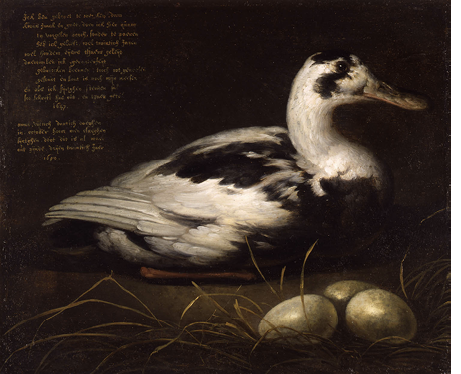
Albert Cuyp, Portrait of the Duck Sijctghen, 1647-1650. Oil on canvas. Image courtesy of Mauritshuis, The Hague.
The chapter “Plumage” (p. 86–103), by Martine Gosselink, is about the human fascination and uses of feathers in ritual costumes and fashion. Here we learn of the Netherlands’ campaign to stop the use of feathers in women’s hats. As it had in America, fashions’ use of birds as decoration for large women’s hats had gotten way out of hand as illustrated by several fine satirical cartoons of the time.
Mocking outlandish fashion trends featuring feathers was clearly already in vogue at the end of the eighteenth century, though not because of any suffering caused to the birds.
That changed in the Netherlands in 1892 when the aristocratic sisters Cécile and Else de Jong van Beek en Donk founded the Bond ter Bestrijding eener Gruwelmode (Society for the Abolition of Cruel Fashion). Their aim was to denounce the use of bird feathers in hats and other items of clothing. Queen Emma supported the principles of the society, which quickly attracted hundreds of members. A few years later, in 1899, the Netherlands became the first country in Europe to establish a national bird conservation organization, the Vereeniging tot Berscherming van Vogels (Society for the Protection of Birds). Thirteen years later, all wild birds in the Netherlands were protected by law. (p. 92–3)
Birds is itself an embarrassment of riches. Even if you are familiar with most books on birds and art, Simon Schama and Martine Gosselink’s choice of artworks is thoughtful, sometimes surprising, and even playful. Some works will likely be new to the reader. The written content matches the quality of the art works and has a variety of perspectives.
An artwork that was new to me—and that became one of my favorites—was part of the museum exhibition. It is listed as “Albert Cuyp, Portrait of the Duck Sijctghen, 1647-1650. Oil on canvas.” (p. 83)
For me, this artwork is quintessentially a Dutch “Golden Age” genre work. Despite all my years working with Dutch and Netherlandish art, I could not correctly pronounce the name of the subject. It’s a painting of a large mottled domestic duck by one of the masters of the period. It was painted to celebrate the duck’s prodigious egg-laying ability through its long life.
Birds: The Goldfinch, Birds, Art and Us belongs in the library of anyone who has ever identified a bird in a piece of art.
CITATION
- Schama, Simon. The Embarrassment of Riches: An Interpretation of Dutch Culture in the Golden Age. 1997. Vintage. New York, New York
To listen to Mark Lynch’s interviews with Lorna Gibson (2) and Martine Gosselink (1) for WICN (90.5 FM), go to the following links:
<https://wicn.org/podcast/lorna-gibson-birds-up-close/>
<https://wicn.org/podcast/lorna-gibson-birds-up-close-part-2/>
<https://wicn.org/podcast/martine-gosselink-birds/>