Shaibal S. Mitra (Chair), Paul L

Tropical Kingbird, Albro Woods Preserve, Middletown, Newport County, RI; October 18–22, 2024. Photograph by Louise Ruggeri.
The Seventh Report of the Rhode Island Avian Records Committee (RIARC) presents evaluations of 106 reports involving 52 species from 2023 and 2024. Note that reports of Tundra Bean-Goose from 2025 and American Flamingo from 2024 received expedited review and were published in our Sixth Report (Mitra et al. 2025).
Highlights of the present report include many exceptional records for Rhode Island:
- First records of Mottled Duck, Tropical Kingbird, and Western Flycatcher.
- Second records of Siberian Sand-Plover, Common Gull, and Bell’s Vireo (and also its third).
- Third records of Calliope Hummingbird, Green-tailed Towhee, and Townsend’s Warbler (and also its fourth and fifth).
- Fourth records of White-winged Dove, Northern Lapwing, and Townsend’s Solitaire.
Other notable events included incursions of Thick-billed Murres during both winters and Cave Swallows in November 2024.
In other news, the Committee voted to add three species to the Review List: American Avocet, Tricolored Heron, and Northern Shrike. The first has occurred rarely but regularly over the past 60 years, with 12 records enumerated by Conway (1992) from the first in 1968 through 1991. At some point thereafter, this species lost its status as a “back of the card” vagrant on the Checklist of Rhode Island Birds (Rhode Island Ornithological Club 2002) and was omitted from the original Review List, in part due to its distinctiveness. The latter two species formerly occurred much more frequently but have diminished significantly in recent years. In each case, review seemed appropriate, and the Committee will explore the feasibility of retroactively reviewing records back through 2003 for our next report.
Reports not accepted by the Committee are not published here unless they were submitted to the Committee with the observers’ expressed intention that they be reviewed or in certain cases where records have become well-known through public discussion.
The records are grouped by species, with each species entry followed by four numbers in parentheses (a, b, c, d), defined as follows:
a the number of records cited by Howe and Sturtevant (1899).
b the number of records accepted from 1900–2002. This number is derived from Ferren (2024), the Checklist of Rhode Island Birds (Rhode Island Ornithological Club 2002), Conway (1992), and records accepted by a pre–RIARC committee of reviewers for Field Notes of Rhode Island Birds through 2002 (Raithel 2001, 2002). The symbol “++” represents relatively frequent historical occurrence of the species, which could be replaced with a number pending ongoing research.
c the number of accepted records from 2003–2022, including those published in RIARC’s six previous reports (Mitra et al. 2010, 2021, 2022, 2023, 2024, and 2025), plus additional records from that period published in the current report (none in the present case).
d the number of accepted records from 2023 and 2024, published in the current report.
The sum of a, b, c, and d represents the total number of verified records in Rhode Island through December 2024. For each record below, we list the RIARC report number; the vote of the Committee (accept–not accept); the number of individual birds reported (provided only if the number is greater than one); the location, including town; the date(s) of occurrence; and the observer(s), with the following codes: I (initial finder), R (reported details), P (obtained photograph), and A (obtained audio recording). Reports from multiple observers indicated by “mob.”
Ross’s Goose (Anser rossii) (0, 1, 10, 2); first 2001
- 2023–1 (7–0): Hammersmith Farm, Newport; December 21–29, 2023; Tim Metcalf and Sue Palmer (I, R, P), mob.
- 2024–1 (7–0): Newport Country Club, Newport; January 2 to March 6, 2024; Carlos Pedro (R), mob.
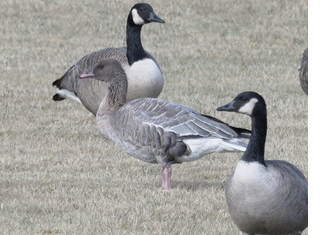
Pink-footed Goose, Bass Rock, Narragansett, Washington County, RI; December 23, 2023. Photograph by Paul L'Etoile.
Pink-footed Goose (Anser brachyrhynchus) (0, 0, 8, 3); first 2007
- 2023–2 (7–0): Bass Rock, Narragansett; December 23, 2023; Paul L’Etoile (I, R, P), mob.
- 2024–2 (7–0): Rhode Island Nurseries, Middletown; March 5–8, 2024; Derek and Jeannette Lovitch (I), Chris Veale (R, P).
- 2024–3 (7–0): Trustom Pond National Wildlife Refuge (NWR), South Kingstown; November 25 to December 7, 2024; Bill Thompson (I, R, P), mob.
The Narragansett bird was originally found on the water off Bass Rock with a flock of Canada Geese. The flock then flew to a nearby oceanfront lawn, where the bird was seen by many.

Mottled Duck, West Side Road, New Shoreham, Washington County, RI; April 27, 2024. Photograph by Joel Eckerson.
Mottled Duck (Anas fulvigula) (0, 0, 0, 1); first 2024
- 2024–4 (7–0): West Side Road, New Shoreham; April 27 to May 2, 2024; Sam Miller and Joel Eckerson (I, R, P), mob.
Found in a small farm pond along West Side Road, Rhode Island’s first Mottled Duck fed and associated with Mallards, which sometimes chased or displaced it. The finders and followers carefully documented its appearance: lightly streaked head; buffy, unstreaked throat; bright yellow bill with a bold black spot on gape; overall coloring intermediate between American Black Duck and female Mallard; thin white tips to the secondaries; absence of white tips to the secondary coverts; absence of any upcurved feathers; and neatly patterned scapulars and flank feathers displaying cleanly marked internal golden chevrons. Collectively, these field marks excluded American Black Duck x Mallard hybrid, pure American Black Duck, pure Mallard, and other Anas species.
An essentially similar-looking Mottled Duck was present in southwestern Suffolk County, Long Island, New York, for weeks during spring 2022 and again in spring 2023, but not in spring 2024 (Healy 2024).
Eared Grebe (Podiceps nigricollis) (0, 28, 6, 4); first 1951
- 2023–3 (7–0): Green Hill, South Kingstown; January 7–8, 2023; Dan Finizia and Sue Talbot (I, R, P), mob.
- 2024–5 (7–0): Weekapaug and Quonochontaug Beach, Westerly; January 2 to April 2, 2024; Patrick Felker (I, R, P), mob.
- 2024–67 (7–0): First Beach, Newport; June 22, 2024; Luis Mendes (I, R, P).
- 2024–68 (7–0): Quonochontaug Beach, Westerly; December 22–24, 2024; Chris Elphick (I, R), Barbara Seith (R), Joseph Koger (R).
Six of the past ten records have been in winter on the oceanfront between Green Hill and Weekapaug between December 2018 and December 2024. At least some of these likely represent a returning individual, although none was noted there in 2020–2021 or 2021–2022. Report 2024–67 is highly unusual involving a bird in breeding plumage on June 22.
White-winged Dove (Zenaida asiatica) (0, 1, 2, 1); first 1999
- 2024–6 (7–0): Beavertail State Park, Jamestown; May 18–20, 2024; Tim Metcalf (R, P), mob.
Chuck-will’s-widow (Antrostomus carolinensis) (0, ++, 11, 1); first 1980
- 2023–4 (7–0): Tillinghast Pond, West Greenwich; May 4–13, 2023; Stuart Bargery (R), mob.
Although one or two territorial birds have been present at Tillinghast Pond most years since 2016, there were no reports from there in 2021 or 2024.
Calliope Hummingbird (Selasphorus calliope) (0, 0, 2, 1); first 2013
- 2023–5 (7–0): Private Yard, Little Compton; October 18–25, 2023; Geoff Dennis (I, R, P).
Like the two that preceded it in 2013, this Calliope Hummingbird fed on flowers in Geoff Dennis’s yard in Little Compton and was never observed at feeders.
Rufous Hummingbird (Selasphorus rufus) (0, 1, 7, 1); first 1995
- 2024–7 (7–0): Private yard, Little Compton; October 26, 2024, to April 4, 2025; Geoff Dennis (I, R, P).
Photos show the width of Rectrix 5 and the diagnostic pinched shape to the tip of Rectrix 2; confirmed this bird as a female by Sheri Williamson. As noted above for the Calliope Hummingbird, Geoff emphasizes that all 13 Selasphorus hummingbirds that have visited his yard and that of a neighbor since 1995 have invariably started out feeding on flowers. It is noteworthy that this individual successfully overwintered, surviving several cold periods with low temperatures below 10° F.
Yellow Rail (Coturnicops noveboracensis) (4, 14, 2, 1); first 1886
- 2023–6 (6–1): Jacob’s Point, Warren; May 18, 2023; Joel Eckerson (I, R).
Purple Gallinule (Porphyrio martinicus) (7, 9, 3, 1); first 1857
- 2024–8 (7–0): Sakonnet Point Road, Little Compton; April 8, 2024; Randall Watt (I), Geoff Dennis (R, P).
Although April has a good track record for vagrant Purple Gallinules in the Northeast, this adult was the first for that month among recent Rhode Island records, the others occurring in February, May, June, and November.
Black-necked Stilt (Himantopus mexicanus) (0, 8, 3, 1); first 1966
- 2024–9 (7–0): Four; private property, Matunuck Schoolhouse Road, South Kingstown; May 21, 2024; Dwayne Mack (I), Sue Palmer (R, P).
A stalled low-pressure system brought sustained northeasterlies to the region during May 10–20, 2024, halting migration throughout much of the Northeast. On the evening of May 20, winds shifted to the south, ushering in a wave of delayed migrants, and with them heavy fog throughout the New York–New Jersey Bight. Disoriented waterbirds were reported from various locations along the Rhode Island coast the morning of May 21, including a Gull-billed Tern (2024–30), Long-tailed Jaeger (2024–18), Black Skimmer, and these four Black-necked Stilts. Four other Black-necked Stilts were reported in the following days from Connecticut to Cape Cod, evidently affected by this system.
American Avocet (Recurvirostra americana) (0, ++, unknown, 1); first 1968
- 2023–7 (7–0): Succotash Marsh, South Kingstown; April 20–26, 2023; Todd McLeish (I, R), mob.
Although this species is distinctive and not difficult to identify, the Committee decided in August 2026 to add it to the Review List. We will explore the feasibility of retroactively reviewing records back through 2003 for our next report.
Northern Lapwing (Vanellus vanellus) (0, 2, 1, 1); first 1932
- 2024–10 (7–0): Scarborough Beach, Narragansett; December 28–29, 2024; Alyssia Church (I), Sue Palmer (R, P), mob.
Rhode Island’s fourth record of Northern Lapwing was found by Alysia Church early on a Saturday afternoon and seen by many birders that day and the next.
Siberian Sand-Plover (Anarhynchus mongolus) (0, 1, 0, 1); first 1999
- 2023–8 (6–1): Napatree Point, Westerly; August 5, 2023; P Carl (I, R, P).
The split of Lesser Sand-Plover (Wei et al. 2022) raises the question of which taxon/taxa is/are involved in records of this true mega-rarity in eastern North America. The dissenting vote reflected this uncertainty, but a second round was neither triggered nor requested. Collectively, the Committee concluded that both phenotypic and geographical evidence support the identification of Rhode Island’s second “Lesser Sand-Plover” as Siberian (ssp. mongolus/stegmanni), as opposed to Tibetan (ssp. atrifrons/pamirensis/schaeferi)—or Greater Sand-Plover (A. leschenaultii). Unlike the well-watched bird in 1999, the current one was seen only by its finder.
Ruff (Calidris pugnax) (0, ++, 11, 1); first 1900
- 2023–9 (7–0): male; Ninigret Pond Mudflats, Charlestown; July 11, 2023; Bill Thompson (I, P), Jan St. Jean (I), Chris Veale (R), mob.
Curlew Sandpiper (Calidris ferruginea) (0, 8, 3, 1); first 1973
- 2024–11 (7–0): Ninigret Pond Mudflats, Charlestown; August 6, 2024; Tim Metcalf (I, R, P), P Carl (P).
Long-billed Dowitcher (Limnodromus scolopaceus) (1, ++, 14, 3); first 1890
- 2023–10 (7–0): Mud Pond, South Kingstown; October 27–29, 2023; Jan St. Jean (I), John Mitchell (R), Sue Palmer (P), mob.
- 2024–12 (7–0): Ninigret Pond Mudflats, Charlestown; August 2, 2024; Bill Thompson (I, R, P).
- 2024–13 (7–0): Succotash Marsh, South Kingstown; December 21, 2024, to May 5, 2025; Sue Palmer (I, R, P), mob.
Accepted records are increasing, with 11 in the 6 years 2019–2024 compared to 6 in the 16 years 2003–2018. This trend probably reflects observers’ increasingly sophisticated detection and documentation of this local and very difficult to identify species.
South Polar Skua (Stercorarius maccormicki) (0, ++, 6, 4); first 1967
- 2024–14 (6–1; second round): Camp Cronin, Narragansett; May 27, 2024; Aaron Graham and ariella malfaro (I, R, P).
- 2024–15 (7–0): Two; Pelagic, southeast of Block Island; July 2, 2024; nine observers (I), Tim Metcalf (P).
- 2024–16 (7–0): Two; Pelagic, East Grounds (east of Block Island); July 9, 2024; Paul L’Etoile (I, R, P).
- 2024–17 (7–0): Pelagic, east of Block Island; August 17, 2024; Scott Tsagarakis (I), Claudia Cooper and Jennifer Leitao (P).
Viewing conditions are often challenging for this and other seabirds, and that results in much variation in the quality of documentation. With respect to the large skuas, much evidence has accumulated demonstrating regular occurrence in Rhode Island waters by South Polar Skuas in late spring and summer in contrast to very rare occurrence by Great Skuas in winter and early spring. Even so, the Committee continues to review reports of these species from the perspective of documentation as opposed to simple probability. All the reports published here not only fit the expected seasonal pattern for South Polar Skua but also included evidence supporting that identification over Great Skua.
Long-tailed Jaeger (Stercorarius longicaudus) (0, ++, 3, 1); first 1952
- 2024–18 (7–0): Blue Shutters Beach, Charlestown; May 21, 2024; Sue Palmer (I, R, P).
Though this species is expected offshore, land-based records remain exceedingly rare in Rhode Island. This bird was documented during a discrete waterbird displacement event on May 21, 2024, which produced unusual records throughout the Rhode Island coast, including a Gull-billed Tern (2024–30) and four Black-necked Stilts (2024–9).
Thick-billed Murre (Uria lomvia) (++, ++, 12, 6)
- 2023–11 (7–0): Point Judith-Block Island ferry; February 27, 2023; Shai Mitra (I, R).
- 2023–12 (7–0): Moonstone Beach, South Kingstown; March 3, 2023; Steve Ruscito (I, P).
- 2023–13 (7–0): State Pier Number 5 (Monahan’s Dock), Narragansett; October 19, 2023; Christopher Veale (I, R, P).
- 2024–21 (7–0): Old Harbor, New Shoreham; February 19, 2024; Shai Mitra (I, R, P).
- 2024–22 (7–0): Beavertail State Park, Jamestown; February 22, 2024; Steve Ruscito (I, P), Allison O’Connor (R), mob.
- 2024–23 (7–0): Point Judith-Block Island ferry; March 4, 2024; Christopher Veale (I, R, P).
Occurrence of this species in Rhode Island is highly variable, not only from year to year but over longer periods as well. From 2003 to 2013, during the first 11 years of formal review, just a single Thick-billed Murre was recorded. In contrast, at least 17 occurred during the next 11 years, 2014–2024.
Atlantic Puffin (Fratercula arctica) (0, 10, 5, 2); first 1921
- 2023–14 (7–0): Pelagic, Cox’s Ledge; January 21, 2023; Paul L’Etoile (I, R, P).
- 2024–24 (7–0; second round): Pelagic, about 15 miles southeast of Block Island; May 31, 2024; Sue Palmer (I, R, P).
Little Gull (Hydrocoloeus minutus) (0, ++, 7, 6); first 1946
- 2023–15 (7–0): Andy’s Way, New Shoreham; August 20, 2023; Jan St. Jean (I, R, P).
- 2023–16 (7–0): Moonstone Beach, South Kingstown; December 27, 2023; Christian Nunes (I, R, P).
- 2024–25 (7–0): Two adults; Matunuck, South Kingstown; January 9–16, 2024; Sam Miller (I, P), Chris Veale (R), mob.
- 2024–26 (7–0): First summer; Napatree Point, Westerly; June 6, 2024; Rachel Orlando (I, R, P).
- 2024–27 (7–0): First summer; Napatree Point, Westerly; June 24–25, 2024; Bill Thompson (I, R, P), Luis Agosto (I, R, P).
- 2024–28 (7–0): First winter; Brenton Point State Park, Newport; November 9, 2024; Matthew Eckerson (I, R, P).
Common Gull (Common) (Larus canus canus/heinei) (0, 0, 1, 1); first 2022
- 2023–17 (7–0): subspecies canus/heinei; Colt State Park, Bristol; January 18 to February 26, 2023; Joel Eckerson, Deirdre Robinson, and Jim O’Neill (I, R, P), David Mozzoni (R, P).
Rhode Island’s second confirmed “Common” Common Gull followed quickly after the first, from 2022. Excellent documentation obtained by the finder sufficiently ruled out Kamchatka and Short-billed gulls by primary pattern and mantle shade. Early Rhode Island records of broad-sense “Mew Gull” from 1974 and 1995 were not documented in sufficient detail to establish their identities (European canus heinei, East Asian kamtschatschensis, or North American brachyrhynchus).
Sooty Tern (Onychoprion fuscatus) (2, 10, 3, 1); first 1876
- 2024–29 (7–0): Sakonnet Point, Little Compton; August 10, 2024; Sam Miller (I, R, P).
This southbound adult Sooty Tern was likely displaced by the remnants of Hurricane Debby, which deposited large numbers of Sooty Terns throughout western Florida and into the Carolinas. Photos.
Gull-billed Tern (Gelochelidon nilotica) (0, 29, 4, 3); first 1944
- 2023–18 (7–0): Ninigret Pond Mudflats, Charlestown; June 16, 2023; Bill Thompson (I, R, P).
- 2024–30 (7–0): East Beach, Charlestown; May 21, 2024; Paul L’Etoile (I, R, P).
- 2024–31 (7–0): Three; Ninigret Pond Mudflats, Charlestown; July 3, 2024; Bill Thompson (I, R, P).
Sandwich Tern (Thalasseus sandvicensis) (0, 23, 8, 2); first 1960
- 2023–19 (7–0): Ninigret Pond Mudflats, Charlestown; June 28, 2023; P Carl (I, R, P).
- 2023–20 (7–0): Camp Cronin, Narragansett; July 19, 2023; John Bean (I, R).
Pacific Loon (Gavia pacifica) (0, ++, 20, 3); first 1941
- 2023–21 (7–0): Moonstone Beach, South Kingstown; November 26 to December 1, 2023; Dan Berard (I, R, P).
- 2023–22 (6–1): Southeast Point, Block Island, New Shoreham; December 14, 2023; Mike McBrien (I, R).
- 2024–32 (7–0): Coast Guard Beach, New Shoreham; October 21 to November 17, 2024; Aaron Graham (I, R, P), mob.
Sargasso Shearwater (Puffinus lherminieri) (0, ++, 5, 1); first 1938
- 2024–33 (7–0): Pelagic, about 30 miles southeast of Point Judith; August 24, 2024; Barbara Sherman (I), Sam Miller (R, P).
Unusual this far inshore over shallow shelf waters.
Magnificent Frigatebird (Fregata magnificens) (0, 10, 5, 1); first 1932
- 2023–23 (7–0): Jerusalem, Camp Cronin, Narragansett; June 25 to July 3, 2023; Don Pelley (I, P), Chris Veale (R), mob.
American White Pelican (Pelecanus erythrorhynchos) (0, 8, 10, 1); first 1946
- 2024–34 (7–0): Briggs Beach, Little Compton; October 23 to December 1, 2024; Richard Blades (I, P), Geoff Dennis (R, P).
Brown Pelican (Pelecanus occidentalis) (0, 14, 12, 2); first 1921
- 2023–24 (7–0): Moonstone Beach, South Kingstown; January 4, 2023; Sue Palmer (I, R, P).
- 2024–35 (7–0): Block Island NWR, New Shoreham; September 1, 2024; Aaron Graham (I, R, P), Sam Miller (I, R, P).
Presumably the same individual relocated about 30 miles northeast in Westport, Massachusetts, the following day, before making short jaunts to Gooseberry Neck and Allens Pond (September 11–13), Fairhaven (September 13), and Bourne (September 14).
Tricolored Heron (Egretta tricolor) (0, ++, unknown, 3); first 1949
- 2023–25 (7–0): Succotash Marsh, South Kingstown; May 25, 2023; Barbara Seith (I, R, P).
- 2023–26 (7–0): Napatree Point, Westerly; June 11, 2023; Michael Ingles (I, R, P).
- 2024–36 (7–0): Block Island NWR, New Shoreham; April 27 to May 10, 2024; Joel Eckerson and Sam Miller (I, R, P), John Young.
Noting a decrease in frequency of occurrence, the Committee decided in August 2026 to add this species to the Review List. We will explore the feasibility of retroactively reviewing records back through 2003 for our next report.
White Ibis (Eudocimus albus) (0, 6, 5, 1); first 1954
- 2024–37 (7–0): Seven; John H. Chafee NWR, Narragansett; August 18–22, 2024; Al Schenck and Adoniram Sides (I), Kara Zanni (I, P), Barbara Seith (R, P), mob.
White-faced Ibis (Plegadis chihi) (0, 2, 15, 3); first 1998
- 2023–27 (7–0): Marsh Meadows, Jamestown; April 8–10, 2023; Ann Gray (I, P), Chris Veale (R), mob.\
- 2023–28 (7–0): Avondale Farm, Westerly; April 18, 2023; Ann Gray (I, R, P).
- 2024–38 (7–0): Two; 34 Camp Thomas Way, North Kingstown; June 22–23, 2024; Sherri Stearns (I, P), Jan St. Jean (R, P), mob.
Records have increased in recent decades due to population increases and eastward expansion of the breeding range, and perhaps due also to increased observer awareness. It hybridizes extensively where range overlaps with Glossy Ibis (Oswald et al. 2019), and recent observations from New Jersey and Rhode Island suggest hybridization could be occurring through vagrants in the East as well.
Golden Eagle (Aquila chrysaetos) (5, ++, 10, 1); first 1887
- 2024–39 (7–0): Burlingame State Park Campground, Charlestown; November 2, 2024; Tim Metcalf (R, P), Sue Palmer (R, P), mob.
Mississippi Kite (Ictinia mississippiensis) (0, 6, 19, 3); first 1986
- 2024–40 (7–0): T. F. Green International Airport, Warwick; May 24–31, 2024; Andy Eckerson (I, R), mob.
- 2024–41 (7–0): Charlestown Beach Road, Charlestown; May 25–28, 2024; Aaron Graham (I, R, P), mob.
- 2024–42 (7–0): Francis Carter Preserve of the Nature Conservancy, Charlestown; June 2, 2024; Christopher Veale (I, R, P).
Records of Mississippi Kite have been increasing, fueled by rapid expansion of the breeding range and culminating in Rhode Island’s first breeding record in 2019.
Tropical Kingbird (Tyrannus melancholicus) (0, 0, 0, 1); first 2024
- 2024–43 (7–0): Albro Woods Preserve, Middletown; October 18–22, 2024; Lauren Parmalee (I), Louise Ruggeri (I, P, A), Allison O’Connor (R), mob.
The identity of Rhode Island’s first Tropical Kingbird was confirmed quickly via Louise Ruggieri’s audio recordings and via expert documentation and analysis by many observers. Records of this species in eastern North America have been increasing rapidly in recent years (Veit et al. 2022).
Western Kingbird (Tyrannus verticalis) (0, ++, 11, 1); first 1913
- 2023–29 (7–0): Matunuck School House Road, South Kingstown; October 29 to November 16, 2023; Dan Berard (I, R, P), mob.
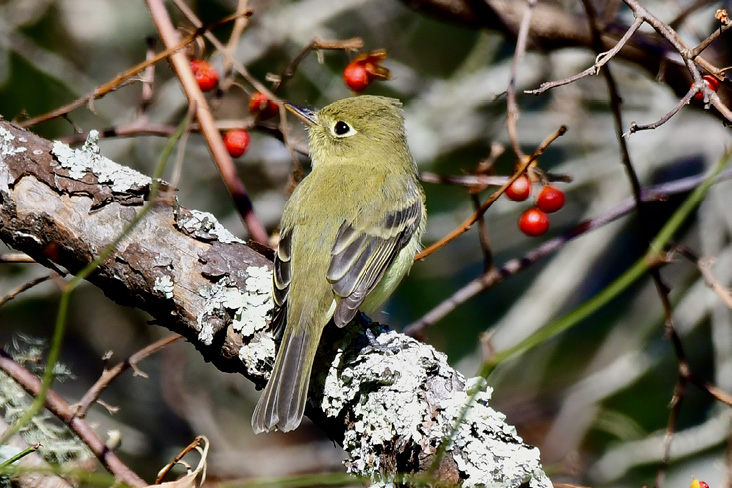
Western Flycatcher, Burlingame State Park Campground, Charlestown, Washington County, RI; November 20, 2023. Photograph by Sue Palmer.
Western Flycatcher (Empidonax difficilis) (0, 0, 0, 1); first 2023
- 2023–30 (7–0): Burlingame State Park Campground, Charlestown; November 20, 2023, to January 15, 2024; Carlos Pedro (I, P), Alex Lin-Moore (R), mob.
Whereas some other eastern states recorded their first Western Flycatchers during the period when the “Cordilleran” and “Pacific-slope” taxa were regarded as separate—but almost indistinguishable—species, Rhode Island’s first occurred following their lumping and with the hindsight of prior records in Massachusetts and New York. That said, identification of Empidonax is always challenging, and this discovery by Carlos Pedro adds to his already long and illustrious résumé of mega-rarities in Rhode Island.
Say’s Phoebe (Sayornis saya) (0, 4, 1, 1); first 1962
- 2023–31 (7–0): Snake Den Farm, Johnston; October 13, 2023; Al Schenck (I, P), Alex Lin-Moore (R), mob.
Bell’s Vireo (Vireo bellii) (0, 0, 1, 2); first 2007
- 2023–32 (7–0): Fishermen’s Memorial State Park, Narragansett; November 11–16, 2023; Sam Miller and Liam Corcoran (I, P), Chris Veale (R), mob.
- 2023–33 (7–0): Sachuest Point NWR, Middletown; December 30, 2023; Jorge de Leon Cardozo and Susan Hochgraf (I, R, P).
Rhode Island’s second Bell’s Vireo was yet another extraordinary find by Liam Corcoran and Sam Miller. Astonishingly, the third followed not long after and was found by Jorge de Leon Cardozo and Susan Hochgraf at the same site as Rhode Island’s first, from Patty O’Neill in 2007.
Northern Shrike (Lanius borealis) (++, ++, unknown, 3)
- 2023–34 (7–0): Snake Den Farm, Johnston; December 19, 2023; Allen Schenck (I, R).
- 2024–44 (7–0): Eight Rod Farm & Pond Wildlife Management Area, Tiverton; January 27, 2024; Jim Sweeney (I, R, P, A).
- 2024–58 (7–0): Sapowet Avenue, Tiverton; March 26, 2024; Robert D. Emerson (I, R, P).
Noting a decrease in frequency of occurrence, the Committee decided in August 2026 to add this species to the Review List. We will explore the feasibility of retroactively reviewing records back through 2003 for our next report.
Cave Swallow (Petrochelidon fulva) (0, 2, 20, 9); first 1999
- 2024–45 (7–0): Nine; Sakonnet Point, Little Compton; November 9–10, 2024; Evan Lipton (I, R, P), mob.
- 2024–59 (7–0): Five; Brenton Point, Newport; November 9, 2024; Matthew Eckerson, Teddy Miller, Mark Pagliarini, and Matt Zucconi (I, R, P), mob.
- 2024–60 (7–0): Four; Camp Cronin, Narragansett; November 9, 2024; Allison O’Connor (I, R).
- 2024–61 (7–0): 10; Matunuck area, South Kingstown; November 9–15, 2024; Patrick Felker and Casey Manera (I, R, P), mob.
- 2024–62 (7–0): Two; East Beach, Charlestown; November 9, 2024; David Alvarez, Chris Dickson, and Peter Paton (I, R).
- 2024–63 (7–0): Six; Napatree Point, Westerly; November 9, 2024; Tim Metcalf, Sue Palmer, and John Mitchell (I, R, P).
- 2024–64 (7–0): Five; Misquamicut area, Westerly; November 12, 2024; Sue Palmer (I, R, P), C. J. Stelzel (R).
- 2024–65 (7–0): Avondale Farm, Westerly; November 13, 2024; Laura Carberry and Don Heitzmann (I, R).
- 2024–66 (7–0): Two; Misquamicut area, Westerly; November 23, 2024; Barbara Seith (I, R).
The flight of November 9, 2024, was the largest yet in Rhode Island, spanning most of the favorable vantages on the outer coast. The numbers presented are minima per site per day. Although it is possible that some individuals were observed at more than one site as they moved westward, it is equally likely that the total numbers present at some sites were underestimated.
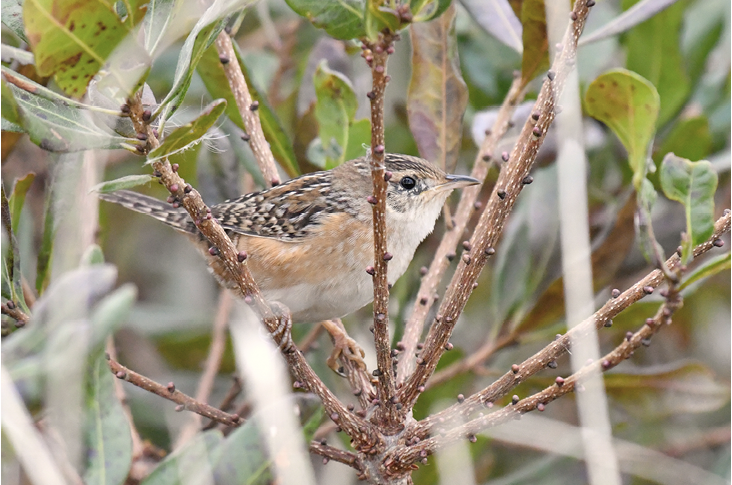
Sedge Wren, Napatree Point, Westerly, Washington County, RI; October 3 to December 16, 2023, here October 31; Photograph by Sam Miller.
Sedge Wren (Cistothorus stellaris) (uncertain, ++, 4, 3); first uncertain
- 2023–35 (7–0): Napatree Point, Westerly; October 3 to December 16, 2023; Sam Miller (I, R, P), mob.
- 2024–46 (7–0): East Beach, west of Charlestown Breachway, Charlestown; August 15, 2024; Sam Miller (I, R, A).
- 2024–47 (7–0): Chase Farm, Lincoln; October 28–31, 2024; Alan Kneidel (I, A), Allen Schenck (R), mob.
The three records from 2023–2024 published here almost equal the four accepted previously in the RIARC era (2003–2022). That two of them were found by the same person, Sam Miller, and the other also by a member of this committee suggests that search strategy and detection are improving.
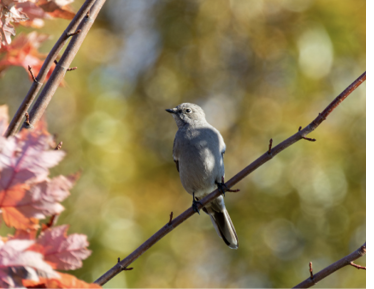
Townsend’s Solitaire, Godena Farm, Jamestown, Newport County, RI; November 11, 2023. Photograph by Dan Berard.
Townsend’s Solitaire (Myadestes townsendi) (0, 2, 1, 1); first 1978
- 2023–36 (7–0): Godena Farm, Jamestown; November 25–28, 2023; Dan Berard (I, P), John Mitchell (R), mob.
Found by Dan Berard at Godena Farm, this Townsend’s Solitaire was just the fourth for Rhode Island and remained long enough to be seen by many observers.
Green-tailed Towhee (Pipilo chlorurus) (0, 1, 1, 1); first 1995
- 2023–37 (7–0): Sachuest Point NWR, Middletown; January 19 to April 20, 2023; Sue Collins (I, R, P), mob.
In a peculiar echo of the paired records of Bell’s Vireo described above, this mega-rarity (third state record) was found by Sue Collins at Sachuest Point, close to where the second state record had been found by Paul L’Etoile in 2010.
LeConte’s Sparrow (Ammospiza leconteii) (0, 1, 5, 1); first 1993
- 2024–49 (7–0): Block Island Substation Marsh, New Shoreham; October 10, 2024; Joel Eckerson (I), Sam Miller (R, P), mob.
Boat-tailed Grackle (Quiscalus major) (0, 2, 4, 1); first 1985
- 2024–50 (7–0): Quonochontaug Breachway, Charlestown; May 23 to June 10, 2024; D. Edward Davis (I, R), mob.
Black-throated Gray Warbler (Setophaga nigrescens) (0, 4, 1, 2); first 1921
- 2024–51 (7–0): Block Island NWR, New Shoreham; September 2, 2024; Aaron Graham (I, R), Sam Miller (I, R, P).
- 2024–52 (7–0): Walker Farm, Bristol; October 4–7, 2024; Joe Koger (I, R) mob.
Townsend’s Warbler (Setophaga townsendi) (0, 1, 1, 3); first 1990
- 2023–38 (7–0): Swan Point Cemetery, Providence; November 23–28, 2023; Alan Kneidel (I, R, P), mob.
- 2024–53 (7–0): Swan Point Cemetery, Providence; January 3–5, 2024; Melanie Torres (I, R), Annabella Helman (I, R), Paul Dougherty (I, R, P), mob.
- 2024–55 (7–0): 100 Hollyberry Hill, Little Compton; December 14, 2024; Tim Metcalf (I, P), Sue Palmer (R, P), Scott Tsagarakis, Carlos Pedro.
Western Tanager (Piranga ludoviciana) (0, 7, 7, 1); first 1953
- 2023–39 (7–0; second round): Franklin Farm, Cumberland; October 19, 2023; Daniel DaCunha (I, R).
Painted Bunting (Passerina ciris) (1, 8, 8, 2); first 1953
- 2024–56 (7–0): 194 Little Pond Road, Wakefield, South Kingstown; February 17–18, 2024; Chris Veale (R, P), mob.
- 2024–57 (7–0): Avondale Farm, Westerly; December 22, 2024, to January 2, 2025; Andrew Dasinger, Glenn Williams (I, R), mob.
Corrigenda
Of the six reports of Magnificent Frigatebird accepted by the RIARC, two were included in the Second Report (see Bird Observer 49 (1):29–53). The report from Little Compton on October 30–31, 2012, was inadvertently described as an immature when it was in fact an adult male, as shown in photographs. The Committee hereby amends the Second Report accordingly.
In the Sixth Report (see Bird Observer 53 (5):293–305), the summary statistics for Golden Eagle were incorrect; they should have read “(5, ++, 9, 1).”
Literature Cited
- Conway, R. A. 1992. Field-checklist of Rhode Island birds, 2nd ed. Rhode Island Ornithological Club Bulletin No. 1. Audubon Society of Rhode Island. 57 pp.
- Ferren, R. L. 2024. Birds of Rhode Island: Seasonal Distribution and Ecological History. Ithaca, New York: Cornell University Press. 559 pp.
- Healy, T. P. 2024. Special Report of the New York State Avian Records Committee: Addition of 17 new species to the New York State Checklist. Kingbird 74:218–235.
- Howe, R. H. and E. Sturtevant. 1899. The Birds of Rhode Island. Privately printed. 111 pp.
- Mitra, S. S., D. Wilson, R. Emerson, R. Farrell, R. Ferren, C. Raithel, and S. Tsagarakis. 2010. First Report of the Rhode Island Avian Records Committee. Bird Observer 38 (5):275–283.
- Mitra, S. S., D. Wilson, R. Emerson, R. Farrell, R. Ferren, P. L’Etoile, P. Paton, C. Raithel, and S. Tsagarakis. 2021. Second Report of the Rhode Island Avian Records Committee. Bird Observer 49 (1):29–53.
- Mitra, S. S., D. Wilson, R. Emerson, R. Farrell, R. Ferren, P. L’Etoile, P. Paton, C. Raithel, and S. Tsagarakis. 2022. Third Report of the Rhode Island Avian Records Committee. Bird Observer 50 (4):251–263.
- Mitra, S. S., D. Wilson, R. Emerson, R. Farrell, R. Ferren, P. L’Etoile, P. Paton, C. Raithel, and S. Tsagarakis. 2023. Fourth Report of the Rhode Island Avian Records Committee. Bird Observer 51 (5):336–345.
- Mitra, S. S., D. Wilson, R. Emerson, R. Farrell, P. L’Etoile, P. Paton, and S. Tsagarakis. 2024. Fifth Report of the Rhode Island Avian Records Committee. Bird Observer 52 (4):251–259.
- Mitra, S. S., P. L’Etoile, R. Emerson, R. Farrell, A. Kneidel, S. Miller, and S. Tsagarakis. 2025. Sixth Report of the Rhode Island Avian Records Committee. Bird Observer 53 (5):293–305.
- Oswald, J. A., M. Harvey, R. Remsen, D. Foxworth, D. Dittmann, S. Cardiff, and R. Brumfield. 2019. Evolutionary dynamics of hybridization and introgression following the recent colonization of Glossy Ibis (Aves: Plegadis falcinellus) into the New World. Molecular Ecology 28:1675-1691.
- Raithel, C. J. 2001. 1999 Report of the Rhode Island Rare Bird Committee. Field Notes of Rhode Island Birds 382:19–21.
- Raithel, C. J. 2002. Report of the Rare Bird Committee. Field Notes of Rhode Island Birds 396:24–26.
- Rhode Island Ornithological Club. 2002. Checklist of Rhode Island Birds.
- Veit, R. R., L. L. Manne, and A. V. Ciancimino. 2022. Tropical Kingbird at Staten Island, New York and a northeastwards surge of vagrants to North America. Kingbird 72 (1):2–8.
- Wei, C., M. Schweizer, P. S. Tomkovich, V. Y. Arkhipov, M. Romanov, J. Martinez, X. Lin, N. Halimubieke, P. Que, T. Mu, and Q. Huang. 2022. Genome-wide data reveal paraphyly in the sand plover complex (Charadrius mongolus/leschenaultii). Ornithology 139 (2) ukab085. doi:10.1093/ornithology/ukab085.
