American Woodcock

(Scolopax minor) (AMWO)

Photographic Identification Guide

  • american.woodcock.eggs.pasco.fl.2015.02.04.r.smith.ML642350153.jpg
    0
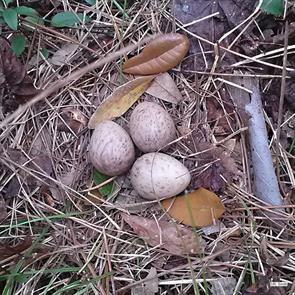
    Fig. 1. American Woodcock eggs, like those of most shorebird species, are pyriform (cone-shaped) to prevent rolling away from the nest. Pasco, FL. 4 February 2015.
  • american.woodcock.bruce.ontario.2023.06.23.zane.shantz.ML595201101.jpg
    0
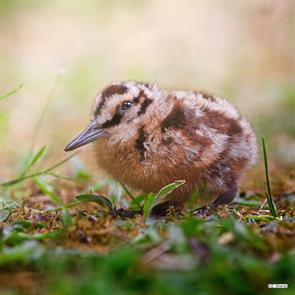
    Fig. 2. American Woodcock chick, newly hatched, is fully downy and mobile but in need of feeding and brooding by the female. Bruce, Ontario. 23 June 2023.
  • american.woodcock.northumberland.ontario.2025.06.27.ismael.chavez.ML638199851.jpg
    0
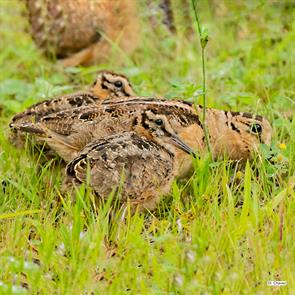
    Fig. 3. American Woodcock female with half-grown chicks. Northumberland, Ontario. 27 June 2025.
  • american.woodcock.northumberland.ontario.2025.06.27.ismael.chavez.ML638199853.jpg
    0
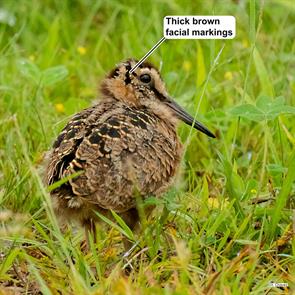
    Fig. 4. American Woodcock semi-grown chick with leftover down. Note thick brown lines on face. Northumberland, Ontario. 27 June 2025.
  • american.woodcocks.union.oh.2025.07.08.hale.edwards.ML638659064.jpg
    0
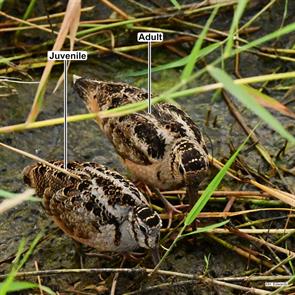
    Fig. 5. American Woodcocks. Note extensive gray on the neck and upper breast, and pale narrow margins to the back (mantle) feathers of the juvenile. Union, OH. 8 July 2024.
  • american.woodcock.cape.may.nj.2024.10.15.daniel.irons.ML641758778.jpg
    0
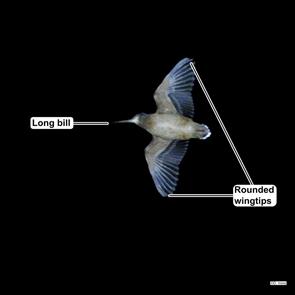
    Fig. 6. American Woodcock overhead in the dark. Cape May, NJ. 15 October 2024.
  • american.woodcock.busch.stadium.st.louis.mi.2025.09.20.chris.stringer.ML642187423.jpg
    0
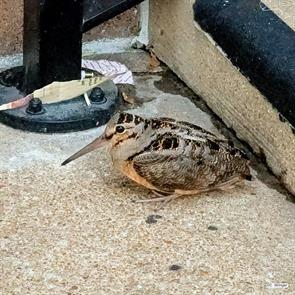
    Fig. 7. American Woodcock migrant. Busch Stadium, St. Louis, MI. 20 September 2025.
  • american.woodcock.champaign.il2009.03.23.fred.lambeth.ML640837660.jpg
    0
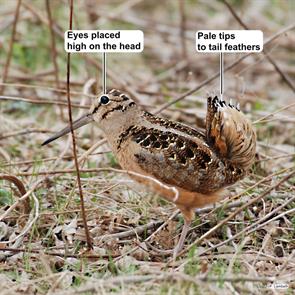
    Fig. 8. American Woodcock male displaying on the ground. This and the flight display are usually performed in semi-dark conditions, at dusk or dawn. Champaign, Il. 23 March 2009.
  • american.woodcock.durham.ontario.2022.3.12.layra.theys.ML643736009.jpg
    0
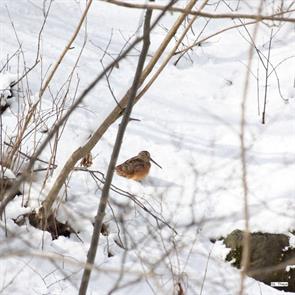
    Fig. 9. American Woodcock is an early spring migrant. Durham, Ontario. 12 March 2022.
  • american.woodcock.paradise.mi.2025.05.29.arjan.brekman.ML640412802.jpg
    0
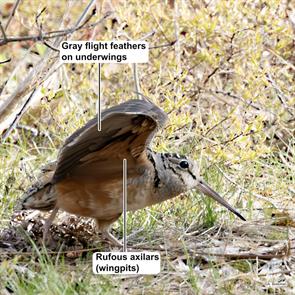
    Fig. 10. American Woodcock. Axillars (wingpits) are rich cinnamon-rufous; flight feathers are gray. Paradise, MI. 29 May 2025.
  • american.woodcock.polk.nc.2025.11.17.keith viglietta.ML645405894.jpg
    0
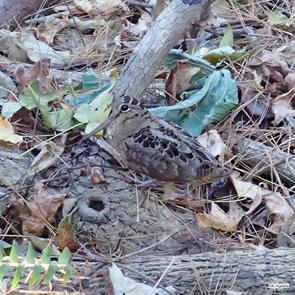
    Fig. 11. American Woodcock, nearly invisible in its woodland habitat. Polk, NC. 17 November 2025.
  • american.woodcock.union.oh.2025.07.18.landon.roberts.ML640425154.jpg
    0
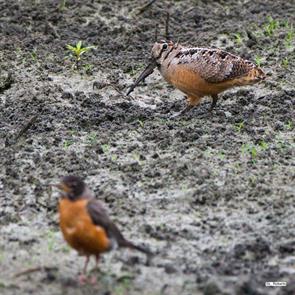
    Fig. 12. American Woodcock and American Robin sometimes share earthworm habitat when feeding. Union, OH. 18 July 2025.
  • american.woodcock.union.oh.2025.07.21.andy.mcgeoch.ML639278197.jpg
    0
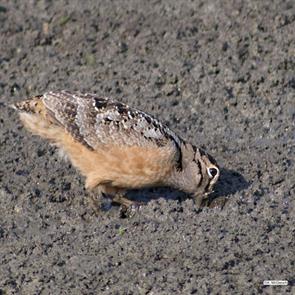
    Fig. 13. American Woodcock. How to catch a worm. Union, OH. 21 July 2025.
  • wilsons.snipe.sarasota.fl.2018.02.26.larry.masters._Q0I4147c.american.woodcock.acadia.2025.09.10.anon.ML642768017.amwo.jpg
    0
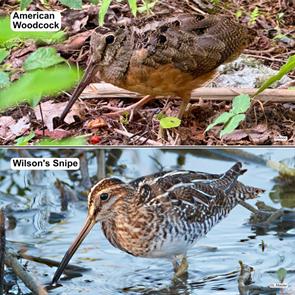
    Fig. 14. Comparison of American Woodcock with Wilson's Snipe. Head stripes are side-to-side on the woodcock, front to back on the snipe. WISN in Sarasota, FL, 26 February 2018; AMWO in Acadia National Park, ME, 10 September 2025.
In this guide, we provide as much detail as possible to help identify this species. The molt sequence for American Woodcock barely follows the usual pattern for most shorebirds; throughout the seasons, most American Woodcock plumages after the downy stage are similar. It is, therefore, difficult to age an individual woodcock without close examination of the plumage. The plumage and molt sequence are summarized below.
Chick: newly hatched bird is precocial, a fluffball of rufous, tan, chestnut brown and black with a thick bill.
See Fig. 2.
Juvenile: a short-lived transitional plumage.
See Fig. 5.
Adult: feathers acquired after juvenile plumage.
See Fig. 8
A common, and at one time abundant, resident of woodlands of eastern North America, American Woodcock is well known for its elaborate spring courtship rituals, which it performs in near-dark conditions at dusk and dawn. Plump and colorful, though cryptically camouflaged, it is a game bird throughout its range. 

Size and weight

Females are larger.
Body length:
female 11–12 in. (28–30.5 cm)
male 10–11 in. (25.4–28 cm) 
Wingspan:
16.5–18.9 in (42–48 cm)
Bill length:
2.3–3.1 in. (5.9–7.8 cm)
Weight:
5–8 oz. (140–230 g)

Calls

High-pitched, often two-syllable warning call, somewhat reminiscent of Black-Bellied Plover, but sharper and higher-pitched.
Peent (Bronx cheer), Allegheny Township, PA, 5/20/2020:
Peent (Bronx cheer) and grunt calls, Hennepin, MN, 4/11/2020:
Peent (Bronx cheer), grunt and display twitter, Scott, VA, 12/3/2020:

Plumage and other characteristics

A sandpiper perfectly camouflaged for life in the woods—that is the American Woodcock; see Fig. 11.

American Woodcock, if seen well, is usually unmistakable: it has a rounded, chunky body, short neck and legs, large head and long, thick, tapered bill; see Fig. 8.

The upperparts are a mixture of rich browns and rufous with broad gray stripes. The underparts are cinnamon-orange, usually with a grayish neck band. There are two broad side-to-side dark brown bars across the top of the head; see. Fig. 5, Fig. 7, Fig. 8.

The eyes are placed very high on the head; the bird can, therefore, see and guard against predators approaching from above or behind; see Fig. 8.

Underwings display rufous-orange axillars (wingpits) and gray flight feathers, The rounded wings tips are well adapted for flying through vegetation in woods; see Fig. 6, Fig. 10.

American Woodcock’s nest is placed on the ground in wooded or shrub habitat. The eggs are pale off-white with light, smudged markings, primarily at the large end; see Fig. 1.

American Woodcock’s chick is a maroon, tan and pale fluffball with large feet and a thick bill. It is precocial, running about shortly after emerging from the egg; see Fig. 2.

The female is solely responsible for incubation and care of the young. Unlike most other shorebirds, American Woodcock young need feeding and attention from the adult female for a week or more after hatching; see Fig. 3.

When partially grown, the chick molts rapidly. Torso down is shed and replaced with feathers resembling the adult. Upper breast, neck and head plumage retains the dark, mottled look of the chick for several more months. Head and facial markings consist of relatively thick brown streaks and marks; see Fig. 4.

After American Woodcock grows its first adult feathers in June or July, its appearance barely changes over the seasons. If seen well, the juvenile may be distinguished by narrow, pale margins on feathers of the back (scapulars and mantle) and wing coverts. Also, the juvenile has a broader gray neck band than the adult; see Fig. 5.

As with many sandpipers, American Woodcock’s bill is soft and flexible. During feeding, it often inserts its bill deep into mud or other soft substrate. The bird can flex the tip of the bill open to grasp prey, usually an earthworm; see Fig. 13.

American Woodcock, at times, bobs its entire body and shuffles its feet; one explanation for this behavior is that it stirs up earthworms, the woodcock’s primary food.

Breeding range, migration, wintering range, habitat

American Woodcocks are widespread, nesting throughout the eastern half of the United States and southeastern Canada.

American Woodcocks are very early spring migrants. Birds often arrive in southern New England by the third week of February, sometimes when there is still snow on the ground; see Fig. 9.

American Woodcock courtship and breeding is primarily polygynous; one male may mate with several females. Overall, the breeding system is often described as lekking behavior. Traditionally, a lek is a shared display area where various males display for the benefit of females. In the case of American Woodcock, each male puts on a dusk or dawn display in an open or brushy field somewhat removed from the normal wooded habitat of the bird. Several males may use adjacent patches of ground for the display. Due to the dispersed nature of the display areas and because a male may use several display areas during a single season, woodcock breeding is considered to be a modified lek or dispersed lek system.

The display starts with repeated peent calls which sound like a Bronx cheer (similar to Common Nighthawk calls heard overhead); sometimes these are interspersed with a guttural single or double grunt. The male then flies up in a circular or zigzag manner, twittering the entire time. At the top of its flight, it whistles and descends steeply, usually landing close to its original take-off site. Both males and females pursue other partners as time and, in the case of females, parental duties allow. Unlike many other species of shorebirds, males do not participate in nest building, incubation or caring for chicks.

Starting in mid-fall, but sometimes as early as September, woodcocks fly south from their nesting areas, often spurred on by cold fronts. The wintering area for birds that breed in New England and eastern Canada is across most of the southeastern United States as far south as central Florida.

American Woodcock migration, in spring and fall, occurs at night. Birds fly low and many are victims of collision with human structures, including city buildings, especially skyscrapers.

Migrating woodcocks occasionally land in incongruous places; this bird, Fig. 7, was photographed at Busch Stadium in St. Louis, Missouri.

Slightly larger than an American Robin, American Woodcock searches out earthworms as its main source of nutrition throughout its range, in winter and summer; see Fig. 12.

Similar species

American Woodcock compared to Wilson’s Snipe

American Woodcock (AMWO) and Wilson’s Snipe (WISN) are long-billed, cryptic-plumaged creatures of woods, swamps or heavily vegetated wetlands; see Fig. 14.

Note the following:

  • American Woodcock is chunkier and rounder; Wilson’s Snipe is slightly longer.
  • The predominant feature of American Woodcock is cryptic or camouflage plumage, imitating dead leaves. Wilson’s Snipe is barred and streaked, imitating grasses and wetland vegetation.
  • Woodcock’s crown is barred with two broad, dark stripes side-to-side. Snipe’s head and face are marked with parallel dark and light stripes front to back.
  • Woodcock is rufous-orange on the belly. Snipe is heavily barred on the flanks; the belly is white.
  • Woodcock’s habitat is mostly woods or wooded swamps. Snipe is often found in water or muddy swamps.

© Copyright 2026 Bird Observer, Inc. and Eric Swanzey.
Website code/design/development by Swanzey Internet Group LLC.
Supporting photography by Just Your Nature.
Privacy Policy | Terms of Use