Hudsonian Whimbrel

(Numenius hudsonicus) (HUWH)

Photographic Identification Guide

  • whimbrel.durham.ontario.2024.08.21.jake.nafziger.ML622803294.jpg
    2
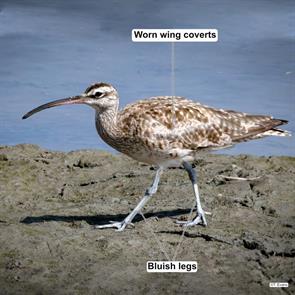
    Fig. 1. Hudsonian Whimbrel juvenile with relatively short bill. Durham, Ontario. 21 August 2024.
  • whimbrels.race.point.2021.08.27.P2870457.jpg
    0
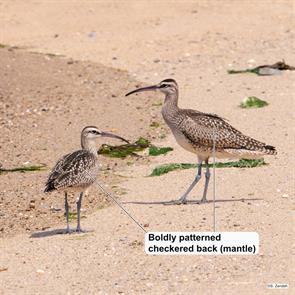
    Fig. 2. Hudsonian Whimbrel juveniles. Race Point, Provincetown, MA; 27 August 2021.
  • whimbrel.winthrop.beach.2015.09.01.IMG_5969.jpg
    1
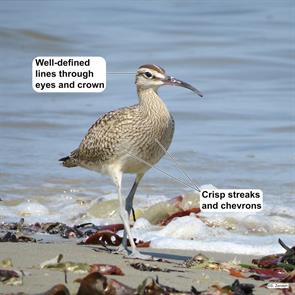
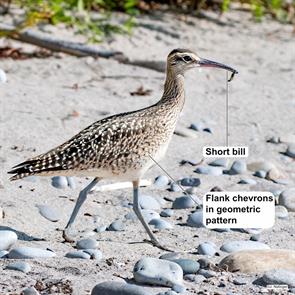
    Fig. 3. Hudsonian Whimbrel juvenile. Note fresh streaks on neck and upper breast, geometric pattern of chevrons on flanks. Winthrop Beach, Winthrop, MA. 1 September 2015.
  • whimbrel.winthrop.beach.2014.09.03.IMG_4394.jpg
    0
    Fig. 4. Hudsonian Whimbrel juvenile. Note geometric pattern of chevrons on the flanks. Winthrop Beach, Winthrop, MA. 3 September 2014.
  • whimbrels.valparaiso.chile.2024.06.01.john.mills.ML626905038.jpg
    0
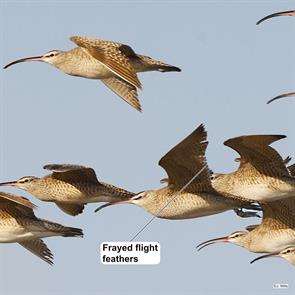
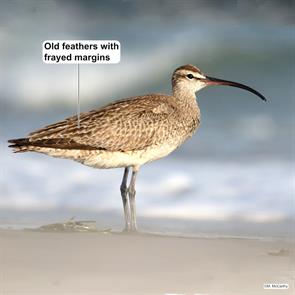
    Fig. 5. Hudsonian Whimbrels. First-year nonbreeders in flight. Note worn and frayed flight feathers. Valparaiso, Chile. 1 June 2024.
  • whimbrel.los.lagos.chile.2009.11.24.jeremy.calvo.ML629360529.jpg
    1
    Fig. 6. Hudsonian Whimbrel adult. Molt to fresh adult plumage is completed near or at wintering area. Los Lagos, Chile, 24 November 2009.
  • whimbrel.los.lagos.chile.2025.02.01.jose.ignacio.catalan.ruiz.ML630024734.jpg
    0
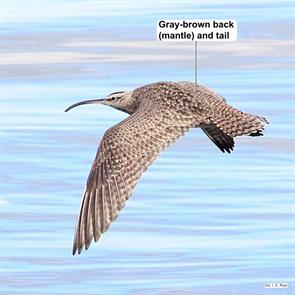
    Fig. 7. Hudsonian Whimbrel in flight. The evenly patterned brownish back (mantle) indicates a recently molted adult. Los Lagos, Chile. 1 February 2025.
  • whimbrel.bolivar.2017.04.13.P1490260.jpg
    0
    Fig. 8. Hudsonian Whimbrel breeding adult. Note checkered back (mantle) feathers with conspicuous dark shafts. Bolivar Peninsula, TX. 13 April 2017.
  • hudsonian.whimbrel.lake.in.2024.06.02.donald.estep.ML619965783.jpg
    0
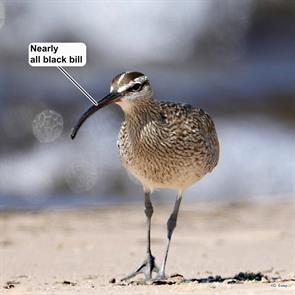
    Fig. 9. Hudsonian Whimbrel breeding adult with nearly all dark bill. Note slight webbing between toes. Lake, IN. 2 June 2024.
  • whimbrel.orange.ca.2024.06.21.trevor.evans.ML623272855.jpg
    0
    Fig. 10. Hudsonian Whimbrel. Summer adult with frayed plumage. Orange, CA. 21 June 2024.
  • whimbrel.barnegat.nj.2018.08.06.max.mccarthy.ML120264661.jpg
    0
    Fig. 11. Hudsonian Whimbrel. Molting adult. Note tertial feathers with pale, very narrow and jagged margins. Barnegat, NJ. 6 August 2018.
  • whimbrel.long-billed.curlew.yolo.ca.2017.07.09.digibirdtrek.ca.ML62996951.jpg
    0
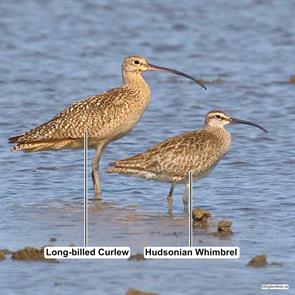
    Fig. 12. Comparison of Hudsonian Whimbrel with Long-billed Curlew. Note overall buffier color of curlew. Yolo, CA. 9 July 2017.
  • whimbrel.western.willet.worcester.md.2024.07.27.tim.carney.ML621960916.jpg
    0
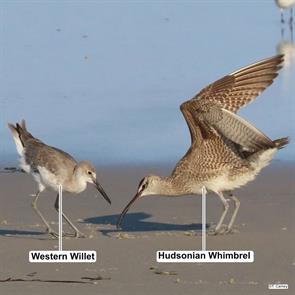
    Fig. 13. Comparison of Hudsonian Whimbrel with Western Willet. Worcester, MD. 27 July 2024.
  • eastern.willets.whimbrels.greater.yellowlegs.barnstable.2020.09.17.alan.kneidel.ML263528691.whim.jpg
    0
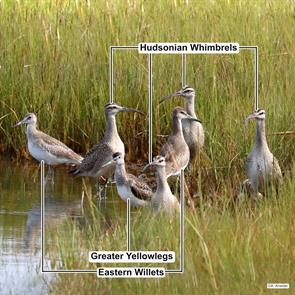
    Fig. 14. Large shorebirds. Compare bill shapes and head patterns. Barnstable, MA. 17 September 2020.
  • whimbrel.greater.yellowlegs.los.lagos.chile.2024.11.07.stephen.wittkamp.ML627681697.jpg
    0
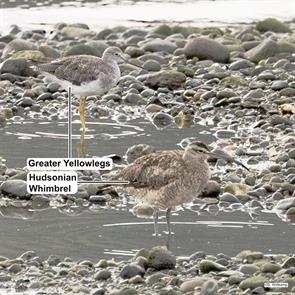
    Fig. 15. Comparison of Hudsonian Whimbrel with Greater Yellowlegs. Note distinctive facial markings of whimbrel. Los Lagos, Chile. 7 November 2024.
  • upland.sandpiper.plymouth.whimbrel.race.point.P2870457..huwh.jpg
    0
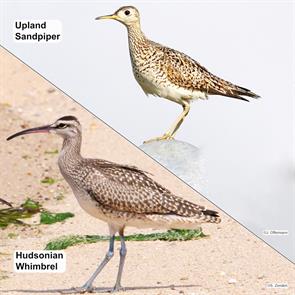
    Fig. 16. Comparison of Hudsonian Whimbrel with Upland Sandpiper. Note differences in facial pattern, leg color. UPSA in Plymouth, MA, 18 June 2023. HUWH in Race Point, MA, 27 August 2021.
  • whimbrels.cantabria.spain.2018.01.12.delfin.gonzalez.ML626646894.jpg
    0
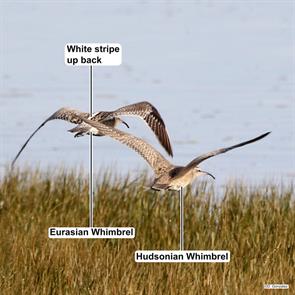
    Fig. 17. Whimbrels in flight. Note grayer tone of Eurasian Whimbrel. Cantabria, Spain. 12 January 2018.
  • whimbrels.cantabria.spain.2018.01.12.delfin.gonzalez.ML626646883.jpg
    1
    Fig. 18. Comparison of Hudsonian Whimbrel with Eurasian Whimbrel. Cantabria, Spain. 12 January 2018.
  • european.whimbrel.laugarvatn.iceland.2018.05.17.P1980973.jpg
    0
    Fig. 19. Eurasian Whimbrel. Laugarvatn, Iceland. 17 May 2018.
In this guide, we provide as much detail as possible to help identify this species. The molt sequence for Hudsonian Whimbrel does not follow the usual pattern for most shorebirds. Throughout the seasons and age classes, most whimbrel plumages are similar. The plumage and molt sequence is summarized below.
Juvenile: young birds, recently fledged, June to October.
See Fig. 1. This plumage is acquired immediately after natal down is shed. 
Adult: feathers acquired after juvenile plumage.
See Fig 6. On most birds, completing this molt requires more than a year.
One of our largest long-distance migratory shorebirds, Hudsonian Whimbrel (Numenius hudsonicus) (HUWH) is a western hemisphere species that has only recently (2025) been taxonomically split off from its congener Eurasian Whimbrel. 

Size and weight

The female is slightly larger and has a longer bill.
Body length:
16–16.75 in. (40–42 cm)
Wingspan:
30.5–35.5 in. (78–89 cm)
Bill length:
juvenile 2–3.1 in. (51–78 mm)
adult 2.9–4.1 in (73–103 mm)
Weight:
11–17.4 oz. (312–493 g)

Calls

Hudsonian Whimbrels produce a variety of calls, alarm noises and songs. The typical call during migration is a repeated too-too-too-too that resembles the alarm calls of Greater Yellowlegs but is slightly mellower and fuller.
Here are some characteristic calls or songs of Hudsonian Whimbrel:
Combined call and song, Nome, AK, 5/25/2013:
Song, Ahome, Sinaloa, Mexico, 4/21/2020:
Flight call, Imperial Beach, CA, 3/17/2021:

Plumage and other characteristics

Hudsonian Whimbrels are large shorebirds with a distinctive lined face and crown, long, down-curved bill and grayish brown plumage in all seasons; see Fig. 3, Fig. 7.

They are long-necked, long-legged birds of open, usually flooded fields, marshes and shores. The long legs are bluish or blue-gray; see Fig. 2, Fig. 10.

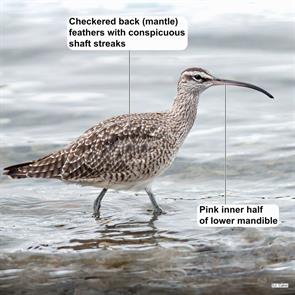
The lower mandible of the long bill is usually pinkish at the base; see Fig. 6.

During breeding season, the bicolored bill of the adult Hudsonian Whimbrel usually becomes darker, often with just a hint of pink or orange at the base; see Fig. 9.

Once the Hudsonian Whimbrel chick sheds its down and develops feathers in June or July, its appearance changes very subtly over the seasons. Through careful study, it is possible to discern juvenile, first year and full adult plumages.

The juvenile bird often has a noticeably shorter bill; see Fig. 1.

As with most shorebirds, juvenile plumage is evenly and neatly patterned. The juvenile’s back (mantle) is boldly marked in a checkered pattern; the neck and upper breast are finely streaked. On the flanks, chevron-shaped marks often overlap to create a geometric polygon pattern; see Fig. 1, Fig. 2, Fig. 3, Fig. 4.

Juveniles begin the molt to first-year adult plumage starting in October or slightly later. This molt may complete between January and April, but often does not include flight feathers or tail feathers. These first-year adults are nonbreeders and mostly remain in South America. The juvenile feathers, including flight feathers, retained by these birds appear very frayed; see Fig. 5.

The molt to full (breeding) adult plumage starts in August to September of the year after hatching and completes in November to January, often near or at the wintering grounds.

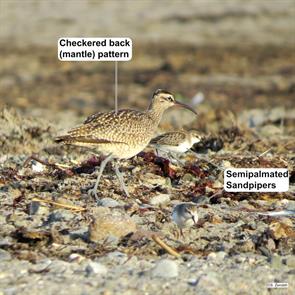
Fresh adult plumage consists of a checkered back (mantle) pattern similar to juvenile plumage. However, neck and breast streaking is more coarse. The centers of mantle feathers are a paler brown than the juvenile. Each feather has pale zigzag margins and a dark, sharply defined central shaft; see Fig. 6, Fig. 8.

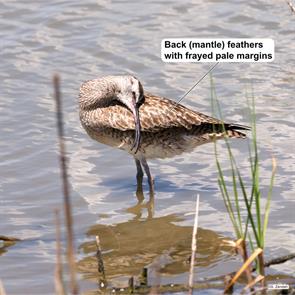
By summer, the margins of the back (mantle) feathers on breeding adults are worn and frayed; see Fig. 10. The pale zigzag margins, being the weakest element of the feather (due to lack of melanin), often wear off first, leaving tertials and other feathers with jagged edges; see Fig. 11.

In flight, Hudsonian Whimbrel’s upperparts are gray-brown. Underparts are mostly pale, but the neck and upper breast are streaked gray and the underwings are barred gray-brown; see Fig. 5, Fig. 7, Fig. 13.

Hudsonian Whimbrels often walk about in tall marsh or grassland vegetation, blending in easily with the surroundings. Their lined faces and heads with long bills can be picked out when they poke out above the tops of the vegetation.

Hudsonian Whimbrel’s toes are moderately webbed, unlike most other shorebirds; see Fig. 9.

Breeding range, migration, wintering range, habitat

There are two separate Hudsonian Whimbrel breeding areas in North America. One is in arctic and subarctic Alaska and northwest Canada; the other is on the southwest coast of Hudson Bay in Canada.

Breeding habitat for Hudsonian Whimbrels consists of subarctic and arctic moors and grasslands adjacent to birch forests, open forests or river valleys and tundra close to the tree line.

When Hudsonian Whimbrel adults first arrive at nesting areas, their primary food source consists of dried berries from the previous growing season; they switch to a heavy diet of insects as those proliferate. Flies, bees, beetles and their nymphs are an important food resource for the young. Some vegetable matter, including arctic flower petals, may supplement the food.

In fall migration, eastern Hudsonian Whimbrels (those nesting in the Hudson Bay region), fly east to the Canadian Maritimes and northeastern United States in order to stage and fatten up for the long migrations ahead. Abundant berries as well as grassland and marine invertebrates are a major food source at this stage.

Areas on Cape Cod, Massachusetts, particularly the marshes at Wellfleet and in Chatham, are reliable fall migration stopover spots for whimbrels.

From eastern Canada and New England, many birds fly directly over the Atlantic Ocean to the Caribbean islands and the north coast of South America. Some trickle south along the east coast of North America, stopping at various sites in the mid-Atlantic and southeastern states before heading to the north coast of South America. From there, Hudsonian Whimbrels appear to take an overland route to the southeast coast of South America.

In the past, Hudsonian Whimbrels and other large shorebirds were shot by sport hunters when they arrived at certain islands of the Lesser Antilles. The practice continues to this day but with less intensity.

Post-breeding Hudsonian Whimbrels from Alaska and western Canada travel south along the west coasts of North America, Central America and South America. Many end up for the winter on the central and southern west coast of South America.

In spring, from their wintering regions in South America, northbound birds follow routes similar to southbound routes. Once they arrive in the United States, western birds follow the coast to Alaska and northwestern Canada.

Eastern birds, migrating north in spring, stage along coasts of south and central Atlantic states. From March to May, many thousands are seen in locations from South Carolina to New Jersey. The flight from the mid-Atlantic states to the Hudson Bay nesting areas is through the Great Lakes region. Spring migrant sightings are scarce in New England and eastern Canada.

During migration and on the wintering grounds, Hudsonian Whimbrels are found in grassy fields, salt marshes and mudflats.

Food during migration and in the winter consists of vegetable matter such as berries and seeds as well as invertebrates such as beetles, spiders and grasshoppers. Crabs of all sorts are a major food source. The Hudsonian Whimbrel’s long, curved bill allows it to dig deep in mudflats while foraging for fiddler crabs, a particular favorite around Cape Cod, Massachusetts. It also takes bivalves, gastropods, fish and marine insects.

First year birds in southern South America usually remain in the wintering areas during the Southern Hemisphere winter (northern summer); see Fig. 5.

Similar species

Hudsonian Whimbrel compared to Long-billed Curlew

Hudsonian Whimbrel (HUWH) is considerably smaller and shorter-billed than Long-billed Curlew (LBCU); for comparison, see Fig. 12.

Note the following:

  • Hudsonian Whimbrel’s head and face are boldly lined with brown stripes. Long-billed Curlew has a relatively bland face with a barely noticeable cap.
  • Hudsonian Whimbrel’s overall color is brownish with gray overtones. Long-billed Curlew’s plumage is buff overall. The underparts may be pale rufous. The upperparts are checkered brown and the upper back is darker than the sides.

Hudsonian Whimbrel compared to Willet

Hudsonian Whimbrel (HUWH) is larger than Eastern Willet (EAWI) and usually slightly larger than Western Willet (WEWI); for comparison, see Fig. 13, Fig. 14.

Note the following:

  • In all plumages, Hudsonian Whimbrel is speckled, checkered and barred brown with a gray cast. Eastern Willet in alternate (breeding) plumage is brownish and speckled. Western Willet is generally much grayer and less heavily streaked and barred.
  • Hudsonian Whimbrel has a very long, downturned bill. Willet has a straight, heavy, thick-based bill with a blunt tip.
  • Hudsonian Whimbrel’s head and face are boldly lined with brown stripes. Willet has a relatively unmarked head and face, with no strong cap and a white spot in front of the eye.
  • In flight, Hudsonian Whimbrel is brownish on the back and tail, barred on the underwings. Willet in flight displays flashing black and white wings, and has a white tail with a pale gray tip.

Hudsonian Whimbrel compared to Greater Yellowlegs

Hudsonian Whimbrel (HUWH) is larger and browner than Greater Yellowlegs (GRYE); for comparison, see Fig. 14, Fig. 15.

Note the following:

  • Hudsonian Whimbrel has a very long downturned bill. Greater Yellowlegs has a long, tapered and often slightly upturned bill.
  • Hudsonian Whimbrel’s legs are blue or blue-gray. Greater Yellowlegs has bright yellow legs.
  • Hudsonian Whimbrel’s head and face are boldly lined with brown stripes. Greater Yellowlegs has a conspicuous eye ring.
  • In flight, Hudsonian Whimbrel is brownish on the back and tail; its underwings are barred. Greater Yellowlegs has plain gray upper wings and the underwings are spotted and barred; its tail is white with pale gray toward the tip.

Hudsonian Whimbrel compared to Upland Sandpiper

Hudsonian Whimbrel (HUWH) and Upland Sandpiper (UPSA) are tall, long-legged shorebirds that roost and feed in similar habitats, see Fig. 16.

Note the following:

  • Upland Sandpiper is about ¾ the size of Hudsonian Whimbrel.
  • Hudsonian Whimbrel’s bill is long and down curved; the base of the lower mandible may be pinkish. Upland Sandpiper’s bill is short, straight and bicolored, with a pale lower mandible.
  • Hudsonian Whimbrel’s head and face are boldly lined with brown stripes. Upland Sandpiper’s face is plain, with a large eye and conspicuous eye ring.
  • Hudsonian Whimbrel’s legs are dark, usually gray or bluish. Upland Sandpiper’s legs are pale, usually yellowish.
  • Hudsonian Whimbrel has checkered grayish-brown mantle plumage. Upland Sandpiper’s back (mantle) is usually speckled buffy or golden.
  • Upland Sandpiper has a very long tail compared to Hudsonian Whimbrel. This is a useful character noted during flight.
  • Hudsonian Whimbrel has streaking on the breast and barring on the flanks. The breast and flank markings on Upland Sandpiper are crisp and chevron shaped.

Hudsonian Whimbrel compared to Eurasian Whimbrel

At least four subspecies of Eurasian Whimbrel breed across arctic and subarctic areas of Europe and Asia. All have a white or pale stripe up the back and a pale or lightly barred tail. This distinguishes them from the Hudsonian Whimbrel with its uniformly brown-barred back and tail; see Fig. 17.

If not seen in flight, these birds are not easily told apart.

Note the following:

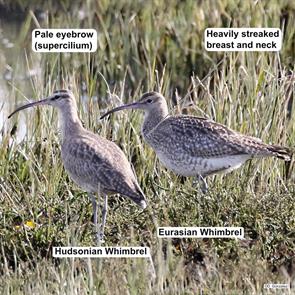
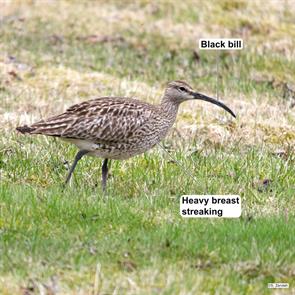
  • Hudsonian Whimbrel is brown. Eurasian Whimbrel is grayer and more crisply marked. It has heavier streaking on the throat and breast during the breeding season; see Fig. 18, Fig. 19.
  • Hudsonian Whimbrel’s eyebrow (supercilium) is very pale, nearly white, compared to the buffy eyebrow of Eurasian Whimbrel; see Fig. 18.
  • In breeding season, Eurasian Whimbrel’s bill is usually all black; see Fig. 19. Hudsonian Whimbrel’s bill at that stage, though nearly all black, usually shows faint pink or orange color at the base of the lower mandible; see Fig. 9.

© Copyright 2026 Bird Observer, Inc. and Eric Swanzey.
Website code/design/development by Swanzey Internet Group LLC.
Supporting photography by Just Your Nature.
Privacy Policy | Terms of Use