Buff-breasted Sandpiper

(Calidris subruficollis) (BBSA)

Photographic Identification Guide

  • buff-breasted.sandpiper.rio.grande.do.sul.brazil.2025.01.08.raphael.kurz.ML629083297.jpg
    1
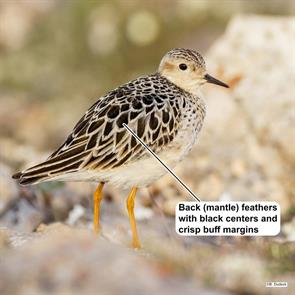
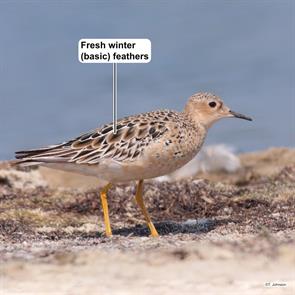
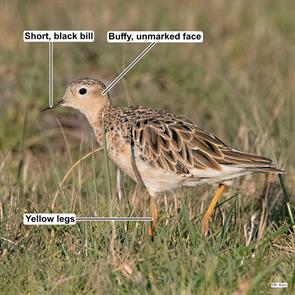
    Fig. 1. Buff-breasted Sandpiper. Winter (basic) plumage. Note brown outer wing covert feathers with bold dark centers and buffy margins. Rio Grande do Sul, Brazil. 8 January 2025.
  • buff-breasted.sandpiper.nanvut.canada.2024.07.12.blair.dudeck.ML626291086.jpg
    1
    Fig. 2. Buff-breasted Sandpiper. Spring (alternate) plumage, subtly different from winter (basic) plumage. Nome, AK. 2 June 2020.
  • buff-breasted.sandpiper.north.slope.ak.2012.06.16.ian.davies.ML27326981.jpg
    1
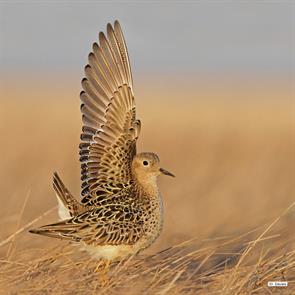
    Fig. 3. Buff-breasted Sandpiper adult male’s single-wing flag-wave. Male uses this display to attract females at a lek. North Slope, AK. 16 June 2012.
  • buff-breasted.sandpiper.north.slope.ak.2012.06.16.ian.davies.ML27326971.jpg
    0
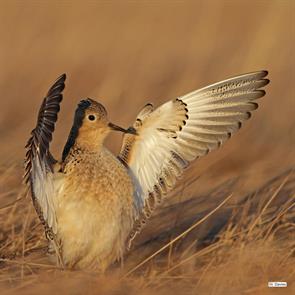
    Fig. 4. Buff-breasted Sandpiper's adult male two-wing display. Used in courtship or territorial display. North Slope, AK. 16 June 2012.
  • buff-breasted.sandpiper.long.island.ny.2009.08.16.tom.johnson.ML68212351.jpg
    0
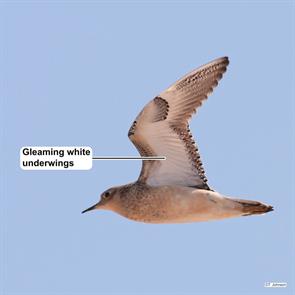
    Fig. 5. Buff-breasted Sandpiper in flight. Note mostly unmarked buffy underparts and white underwings. Long Island, NY. 16 August 2009.
  • buff-breasted.sandpiper.long.island.ny.2009.08.16.tom.johnson.ML68212291.jpg
    0
    Fig. 6. Buff-breasted Sandpiper. Summer (alternate) molting to winter (basic) plumage. Long Island, NY. 16 August 2009.
  • buff-breasted.sandpiper.north.hanover.nc.2023.08.27.sam.zhang.ML608611452.jpg
    0
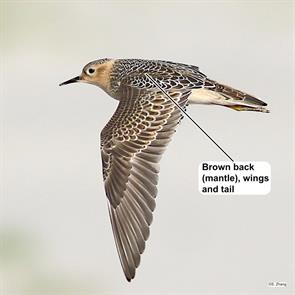
    Fig. 7. Buff-breasted Sandpiper in flight. Note subtle buffy wing stripes. North Hanover, NC. 27 August 2023.
  • buff-breasted.sandpiper.crane.beach.ipswich.ma.2023.09.06.shilo.macdonald.ML608563793.jpg
    1
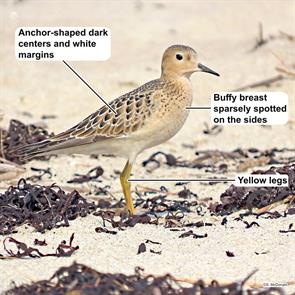
    Fig. 8. Buff-breasted Sandpiper in fresh juvenile plumage. Crane Beach, Ipswich, MA. 6 September 2023.
  • buff-breasted.sandpiper-bairds.sandpiper.park.point.mn.2019.09.01.ted.keyel.ML240215331.jpg
    0
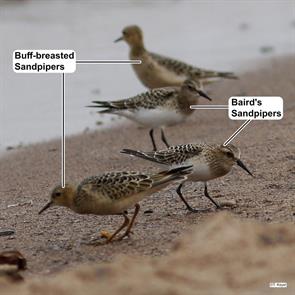
    Fig. 9. Comparison of Buff-breasted and Baird's Sandpiper juveniles. Note differences in breast markings and leg color. Park Point, MN. 1 September 2019.
  • buff-breasted.sandpiper.sanderlings.bairds.sandpipers.semipalmated.sandpiper.park.point.mn.2019.09.01.ted.keyel.ML240219991.jpg
    0
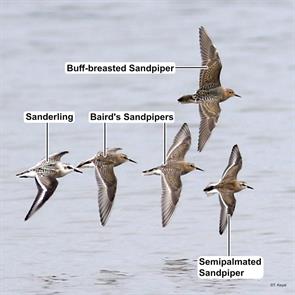
    Fig. 10. Comparison of four small sandpipers in flight. Note lack of prominent wing stripes on Buff-breasted. Park Point, MN. 1 September 2019.
  • buff-breasted.sandpiper.winthrop.2014.09.03.s.zendeh.img_4411.upland.sandpiper.aruba.2019.10.30.michiel.oversteegen.ML185055671.jpg
    0
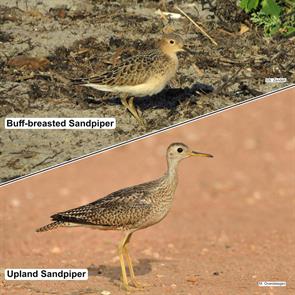
    Fig. 11. Comparison of Buff-breasted and Upland Sandpipers. Note size, tail length, bill length and bill color differences. BBSA, Winthrop Beach, MA, 3 September 2014. UPSA, Aruba, 30 October 2019.
  • reeve.suffolk.england.2025.07.31.peter.kennerley.ML639632810.buff-breasted.sandpiper.nahant.2016.09.02.bbsa.jpg
    0
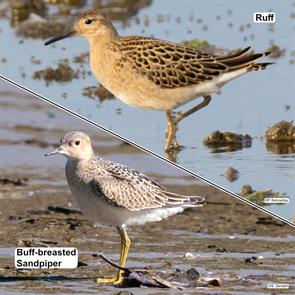
    Fig. 12. Comparison of Buff-breasted Sandpiper with Reeve (female Ruff), both in juvenile plumage. Note size and bill differences as well as differences in leg color. RUFF Suffolk, England, 31 July 2025; BBSA Nahant, MA, 2 September 2016.
In this guide, we cover the features, in order of importance, to look for on these birds. When discussing plumages, we use the terms winter, spring, and summer to refer to northern hemisphere temperate zone seasons. Because most of these birds spend parts of the year in the northern and southern hemispheres, we also use the correct technical terms for the plumage stages—basic and alternate—to help avoid the confusion of seasonal terminology. 
Throughout the seasons, Buff-breasted Sandpiper plumages are somewhat similar. Distinguishing juvenile from winter (basic) or adult breeding (alternate) is tricky without careful and close-up study of plumage. The plumage descriptions below are general guides which may be difficult to apply in the field.
The photos in the album are arranged in this order:
Basic: winter plumage, roughly October to early March.
Buff-breasted Sandpiper adults begin molting to winter (basic) plumage in midsummer. Basic-plumaged birds are found south of the United States border in winter; see Fig. 1.
Alternate: first spring and summer after hatch year or adult breeding plumage, March to July.
Beginning in spring, winter (basic) feathers on Buff-breasted Sandpiper are gradually replaced by spring and summer (alternate) feathers; see Fig. 2
Juvenile: young birds, recently hatched, July to October.
See Fig. 8. These feathers are acquired on the breeding grounds immediately after the natal down is shed and before the young begin their southbound migration.
Buff-breasted Sandpiper (Calidris subruficollis) (BBSA) is among the most elegant of Western Hemisphere shorebirds. A long-distance migrant that nests along the Canadian, Alaskan and Siberian coasts of the Arctic Ocean and winters in central and southwestern South America, Buff-breasted Sandpiper is nearly unique among American shorebirds in its use of a lek as a courtship strategy. The only other North American lekking shorebird is American Woodcock.
A lek is a shared display area where various males display for the benefit of females. In the case of Buff-breasted Sandpiper, pairs mate following encounters at a lek, but form no pair bonds. Both males and females pursue other partners as time and, in the case of females, parental duties allow. Unlike many other species of shorebirds, males do not participate in nest building, incubation or caring for chicks.

Size and weight

Body length:
7.25–8 in. (18–20 cm)
Wingspan:
17.25–18.75 in. (43–47 cm)
Bill length:
0.7–0.8 in. (18–21 mm)
Weight:
1.5–3.3 oz. (43–94 g)

Calls

Buff-breasted Sandpiper courtship calls are described as a series of quiet ticks. Other calls are soft churrs.
Calls in Prudhoe Bay, AK, 2006:
Calls in Rocha, Uruguay, 2005:

Plumage and other characteristics

Buff-breasted Sandpiper, buff-colored in all plumages, is among our most elegant and distinctive shorebirds.

Throughout the seasons, Buff-breasted Sandpiper plumages are similar. Therefore, distinguishing juvenile from winter (basic) or adult breeding (alternate) is not easy without careful and close-up study of plumage. The plumage descriptions below are general guides which may be difficult to apply in the field. Seasonal plumage variations in this species are subtle.

The short bill is dark; the relatively long legs are yellow-orange to dusky yellow. The unmarked buffy face and large dark eyes gives the bird a blank look; see Fig. 1.

The neck, breast and belly are unstreaked. There is sparse brown speckling on the sides of the breast; see Fig. 8.

In winter (basic) plumage, rarely encountered in New England, Buff-breasted Sandpiper’s back (mantle) feathers are brown with boldly delineated dark centers and mostly buffy margins; see Fig. 1.

Beginning in March, the back (mantle) feathers are replaced by spring (alternate) feathers. Though similar to winter (basic) plumage, these feathers have larger blackish centers and broad buff margins; see Fig. 2.

Beginning in August, summer (alternate) feathers begin to molt and are replaced by winter (basic) feathers, which are browner; see Fig. 6.

Newly fledged young birds in juvenile plumage arrive in New England from the Arctic in late August or early September. Close examination of the back (mantle) shows that each feather is paler toward the base and darker toward the tip, with a white margin. The dark portion of the feather often has an anchor shape; see Fig. 8.

In flight from underneath, the buffy body is set off by the gleaming white underwings and dark comma-shaped pattern on the primary underwing coverts; see Fig. 4, Fig. 5.

In flight, the back (mantle), wings and tail are speckled dark brown with no conspicuous white wing stripes. Faint buffy wing stripes may be discerned at close range; See Fig. 7, Fig. 10.

Breeding range, migration, wintering range, habitat

Buff-breasted Sandpiper nests on or close to the northernmost coasts of North America in Canada and Alaska. Its breeding range has spread to easternmost Siberia.

Buff-breasted Sandpiper is only one of two Western Hemisphere shorebirds that use a lek. The other is American Woodcock. At first, males use snow-free areas in the Arctic, usually along barren ridges or other areas with scant vegetation, to display communally for the benefit of females. The display area is not fixed, unlike the leks of most other species that use this courtship system. After the initial phase, males may display in more vegetated areas, including areas with dwarf willow thickets.

Males use the single-wing flag-wave or the two-wing display to advertise their availability to females and their prowess to other males; see Fig. 3, Fig. 4.

Female Buff-breasted Sandpipers select drier sloping areas or ridges to nest in; sometimes the nests are in wet sedge areas.

Males leave the nesting grounds somewhat earlier than females, from mid-June to early July. Females and fledged young depart the Arctic from late July to early September.

Post-breeding, most southbound Buff-breasted Sandpipers migrate using the Central Flyway (Great Plains) in Canada and the United States. They then traverse Central America and inland South America, ending up in south-central or southeastern South America beginning in mid-September.

A few adults and many juveniles leaving the Arctic disperse to the east and west coasts of North America, arriving in New England in late August or early September.

Buff-breasted habitat during migration is often in relatively barren, dry areas: rice fields, turf farms, short-grass areas such as golf courses, cemeteries, airports, lawns, dry mudflats or the upper expanse of beaches.

The majority of the Buff-breasted population winters in coastal or central areas of southern Brazil, Uruguay or northern Argentina, males from November through early February and females from November through early March.

Typical winter habitat consists of drier fields and pastures typically with short grass; sometimes rice fields are also used.

Northbound migration from the wintering grounds is primarily through central South America to northern South America and the Gulf coast. Most Buff-breasteds cross the Gulf of Mexico into Texas and Louisiana in late March before heading north to the Arctic along a narrow migration corridor in the Great Plains. Very few spring migrants are seen on either coast of North America.

Spring migrants in Texas and Louisiana fatten up in agricultural areas, especially rice fields, through April and early May.

Most birds arrive at nesting areas in the Arctic in late May or early June.

In the Arctic, in migration and in winter, Buff-breasted Sandpiper feeds almost exclusively on adults and larvae of terrestrial arthropods. Typical food consists of spiders, ants, earthworms, moth and butterfly larvae, grasshoppers, crickets and adult and larval beetles.

Along with other upland shorebirds such as American Golden-Plover and Eskimo Curlew, Buff-breasted Sandpiper was heavily hunted by market gunners in the late 19th century, and suffered a significant population decline. Populations increased in the early 20th century but have begun to decline again due to multiple factors.

Similar species

Buff-breasted Sandpiper compared to Baird’s Sandpiper

Buff-breasted Sandpiper (BBSA) and Baird’s Sandpiper (BASA) are buff-colored, small sandpipers often found on upper, drier section of beaches or in fields. Buff-breasted is slightly larger; for comparison, see Fig. 9, Fig. 10.

Note the following:

  • Buff-breasted, with its longer legs and neck, often stands upright; the posture of Baird’s is usually more hunched or horizontal.
  • Buff-breasted’s face is relatively unmarked; Baird’s Sandpiper has dark lines through the eyes and pale lines (supercilium) above the eyes.
  • Buff-breasted’s bill is much shorter than Baird’s.
  • Buff-breasted has yellowish or orange-yellow legs; Baird’s legs are dark.
  • Buff-breasted is buffy overall. The buff color extends down from the face to the neck, breast and belly. The sides of the breast are sparsely spotted. Baird’s has brown streaking on the buffy breast that cuts off abruptly; the belly is white.
  • In flight, Buff-breasted shows almost no pale coloration on the upperparts. Baird’s has conspicuous white wing stripes and white on the tail edges.

Buff-breasted Sandpiper compared to Upland Sandpiper

Buff-breasted Sandpiper (BBSA) is about two-thirds the size of Upland Sandpiper (UPSA). The two birds are somewhat similar in having pale legs and lacking strong facial markings; see Fig. 11.

Note the following:

  • Buff-breasted Sandpiper's bill is black. Upland Sandpiper's bill is two toned; the base of the lower mandible is mostly yellowish.
  • Upland Sandpiper's head is small atop a long thin neck. The black eye looks large in the face. Buff-breasted Sandpiper's head and eye shape are similar to many other smaller sandpipers.
  • Upland Sandpiper's tail is very long, extending way beyond the tip of the folded wings. Buff-breasted Sandpiper's wings are even with the tip of the tail or extend slightly beyond it.
  • Buff-breasted Sandpiper's neck and breast are unmarked buffy; the breast sides are sparsely spotted. Upland Sandpiper's neck and breast are streaked or patterned with neat chevon marks.
  • Buff-breasted's wingtips and tail are plain brown with pale or buffy margins. Upland Sandpiper tertials (long feathers that lie over the folder primaries), and tail feathers have dark and light zigzag margins.

Buff-breasted Sandpiper compared to Ruff

Buff-breasted Sandpiper (BBSA) is about one and a half times smaller than Ruff (RUFF). A buffy juvenile Ruff may be confused with Buff-breasted Sandpiper; see Fig. 12.

Note the following:

  • Buff-breasted Sandpiper's bill is short and straight. Ruff's bill is often slightly downturned.
  • Buff-breasted Sandpiper's legs are bright yellow. Ruff's leg color varies greatly depending on the season: yellow, dusky yellow, yellow-orange, orange, pink or greenish.
  • In fall, when both birds in juvenile plumage are likely to be seen in New England, Ruff's back (mantle) plumage is evenly scalloped; each feather has a pale base and dark center set off by a crisp pale margin. Buff-breasted's scapular and upper back feathers are similarly scalloped, but its lower wing coverts are paler and have more complicated patterning; there is a dark submarginal line bordering the pale margin of each feather.
  • In flight, Buff-breasted Sandpiper has brown upperwings and tail with no prominent pale markings. Ruff usually has a pale narrow wing stripe and bold white ovals on the sides of the dark-centered tail.

© Copyright 2026 Bird Observer, Inc. and Eric Swanzey.
Website code/design/development by Swanzey Internet Group LLC.
Supporting photography by Just Your Nature.
Privacy Policy | Terms of Use