Red-necked Phalarope

(Phalaropus lobatus) (RNPH)

Photographic Identification Guide

  • red-necked.phalarope.muscat.oman.2025.02.05.christian.andersen.jensen.ML631057701.jpg
    1
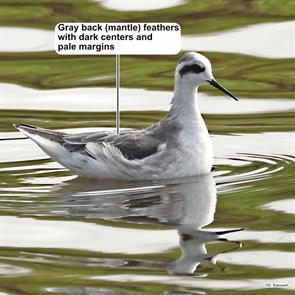
    Fig. 1. Red-necked Phalarope. Winter (basic) plumage. Note gray back (mantle) with some darker feathers. Muscat, Oman. 5 February 2025.
  • red-necked.phalarope.sarawak.malaysia.2025.02.27.dave.bakewell.ML631846254.jpg
    1
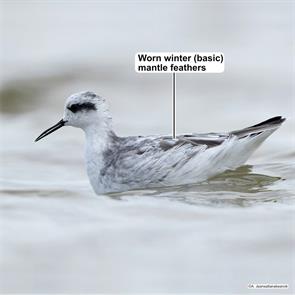
    Fig. 2. Red-necked Phalarope. Winter (basic) plumage. Needle-thin black bill is conspicuous in all plumages. Sarawak, Malaysia. 27 February 2025.
  • red-necked.phalarope.phetchaburi.thailand.2025.03.09.ayuwat.jearwattanakeanok.ML640306311.jpg
    0
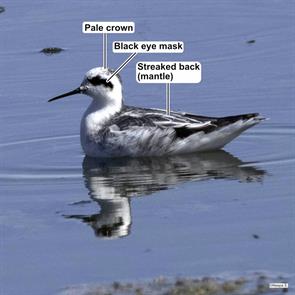
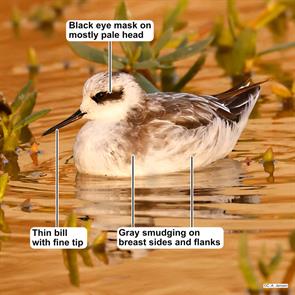
    Fig. 3. Red-necked Phalarope. Winter (basic) adult with worn back (mantle) feathers, thin bill and black eye mask. Phetchaburi, Thailand. 9 March 2025.
  • red-necked.phalarope.mangghystau.oblysy.kazakhstan.2025.04.28.levan.goenner.ML637636220.jpg
    0
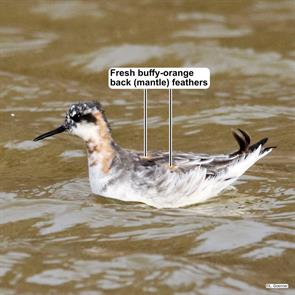
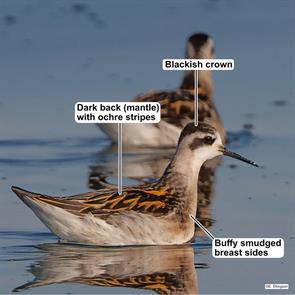
    Fig. 4. Red-necked Phalarope. Winter (basic) molting to spring (alternate) plumage. Mangghystau Oblysy, Kazakhstan. 28 April 2025.
  • red-necked.phalarope5.coast.guard.beach.2023.05.01.jpg
    1
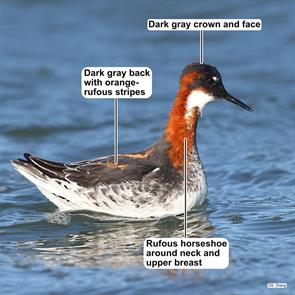
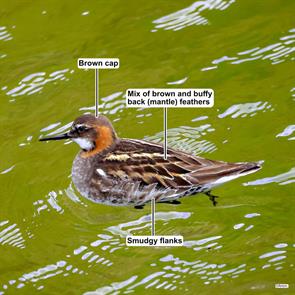
    Fig. 5. Red-necked Phalarope. Adult female in spring (alternate) plumage. Note tiny white spot above eye, white chin and throat, smudgy gray flanks. Coast Guard Beach, Eastham, MA. 1 May 2023.
  • red-necked.phalarops8.nauset.beach.2023.05.01.jpg
    0
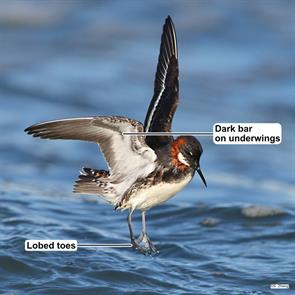
    Fig. 6. Red-necked Phalarope. Adult female in spring (alternate) plumage. Note thin bill, horseshoe-shaped chestnut feathering around neck. Nauset Beach, Orleans, MA. 1 May 2023.
  • red-necked.phalarope.Norðurland eystra.iceland.anon.ML640176196.jpg
    1
    Fig. 7. Red-necked Phalarope. Male in spring (alternate) plumage. Note that chestnut color at back of head and neck does not wrap in front of neck. Norðurland Eystra, Iceland. 29 May 2025.
  • red-necked.phalarope.nauset.beach.2023.05.01.sam.zhang.5D6A1759-1.jpg
    0
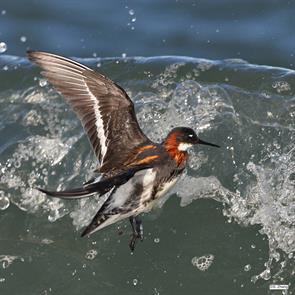
    Fig. 8. Red-necked Phalarope. While migrating over the ocean, some birds get pushed ashore by oceanic storms. Nauset Beach, Orleans, MA. 1 May 2023.
  • red-necked.phalaropes.Vestfirdir, iceland.2023.05.26.hans.peter.fischer.ML640877500.jpg
    0
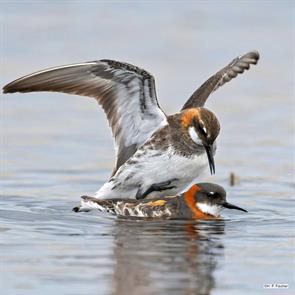
    Fig.9. Red-necked Phalaropes copulating in water. Vestfirðir, Iceland. 26 May 2023.
  • red-necked.phalarope.humboldt.ca.2025.08.21.jeff.todoroff.ML640637174.jpg
    0
    Fig. 10. Red-necked Phalarope. Adult molting from summer (alternate) to winter (basic) plumage. Humboldt, CA. 21 August 2025.
  • red-necked.phalarope.kyongsangbuk-do.s.korea.2025.08.15.fran.kim.ML640460130.jpg
    0
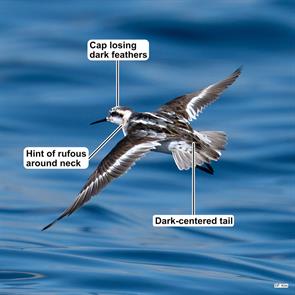
    Fig. 11. Red-necked Phalarope. Flying adult, molting from summer (alternate) to winter (basic) plumage. Kyongsangbuk-do, South Korea. 18 August 2025.
  • red-necked.phalarope.alameda.ca.2025.08.18.neepa.s.ML640506066.jpg
    0
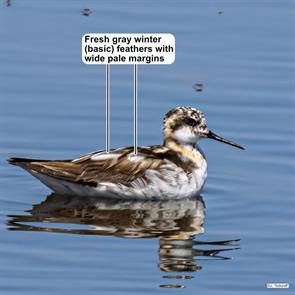
    Fig. 12. Red-necked Phalarope. Adult in transition to winter (basic) plumage. Streaked back (mantle) feathers are often retained until November or later. Alameda, CA. 18 July 2025.
  • red-necked.phalaropes.kyongsangbuk-do.s.korea.2025.08.15.fran.kim.ML640460127.jpg
    0
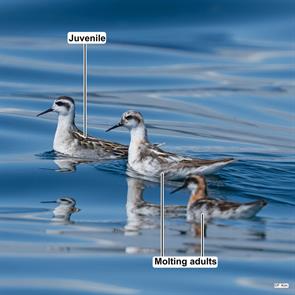
    Fig. 13. Red-necked Phalaropes. Comparison of late summer molting adults with fresh juvenile. Kyongsangbuk-do. South Korea. 15 August 2025.
  • red-necked.phalaropes.whatcom.wa.2025.08.24.eric.ellingson.ML640826230.jpg
    1
    Fig. 14. Red-necked Phalarope. Juvenile in fresh plumage. Juvenile crown remains dark long after adult crown molts to whitish. Whatcom, WA. 24 August 2025.
  • red-necked.phalarope.canakkale.turkey.2025.08.23.cenk.polat.ML640748177.jpg
    0
    Fig. 15. Red-necked Phalarope. Juvenile in fresh plumage. Note dark dorsal plumage with bright, colorful highlights. Çanakkale, Turkey. 23 August 2025.
  • red-necked.phalarope.quabbin.res.2025.09.01.valerie.burdette.DSC_0128.jpg
    0
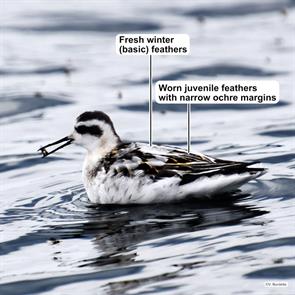
    Fig. 16. Red-necked Phalarope. Worn juvenile. Note dark crown and pale buffy wash on side of neck. Quabbin Reservoir, MA. 1 September 2025.
  • red-necked.phalarope.red.phalarope.nauset.beach.2023.05.01.sam.zhang.IMG_8140.jpg
    0
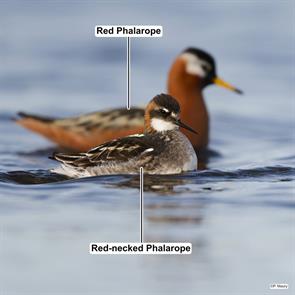
    Fig. 17. Comparison of Red-necked Phalarope with Red Phalarope. Female Red-necked is in full breeding (alternate) plumage. Red is molting to alternate. Note differences in bill shape and color. Nauset Beach, Cape Cod, MA. 1 May 2023.
  • red-necked.phalarope.red.phalarope.nome.ak.2025.06.06.paul.maury.ML640745108.jpg
    0
    Fig. 18. Comparison of male Red-necked Phalarope with female Red Phalarope. Note differences in overall size, bill shape and bill color. Nome, AK. 6 June 2025.
  • red-necked.phalarope.red.phalaropes.bay.of.fundy.2025.07.31.martin.stelbrink.ML639661980.jpg
    0
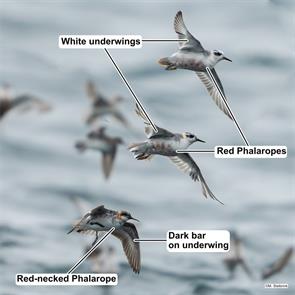
    Fig. 19. Red-necked and Red phalaropes in flight. Adults are mid-molt to winter (basic) plumage. Bay of Fundy, Canada. 31 July 2025.
  • red-necked.phalarope.red.phalaropes.san.mateo.ca.2025.08.17.russell.ryan.ML640610479.jpg
    0
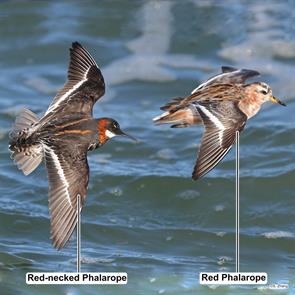
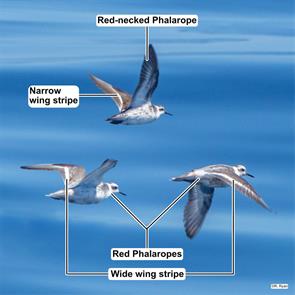
    Fig. 20. Red-necked and Red phalaropes in flight. Note differences in upper wing and underwing patterns. San Mateo, CA. 17 August 2025.
  • red-necked.phalarope.wilsons.phalarope.santa.cruz.ca.2025.09.02.arthur.macmillan.ML641365159.jpg
    0
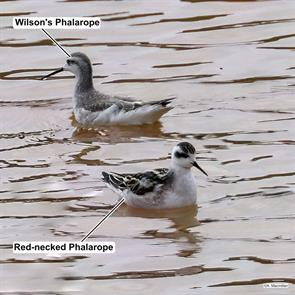
    Fig. 21. Comparison of Red-necked Phalarope with Wilson's Phalarope, both in juvenile plumage. Note longer bill, larger size and grayer plumage of Wilson's. Santa Cruz, CA. 2 September 2025.
  • red-necked.phalarope.semipalmated.sandpiper.werstern.sandpiper.grant.wa.2025.08.25.steve.knapp.ML640844110.jpg
    0
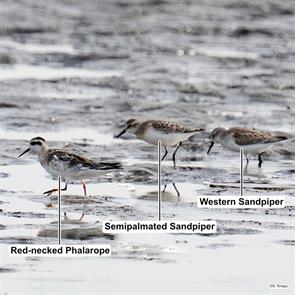
    Fig. 22. Comparison of juvenile Red-necked Phalarope with two peeps. Note phalarope's pale legs. Grant, WA. 25 August 2025.
  • red-necked.phalarope.sanderling.brysna.is.poland.2025.06.02.zbigniew.kajzer.ML640621189.jpg
    0
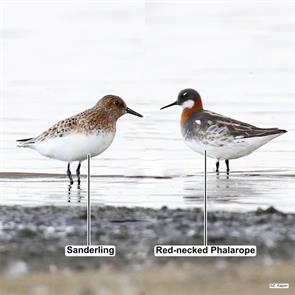
    Fig. 23. Comparison of Red-necked Phalarope with Sanderling, both in breeding (alternate) plumage. Brysna Island, Poland. 2 June 2025.
  • sanderlings.parker.river.2023.10.23.sam.zhang.ML610337241.red-necked.phalaropes.hancock.me.2025.08.23.benjamin.becker.ML641235744.jpg
    0
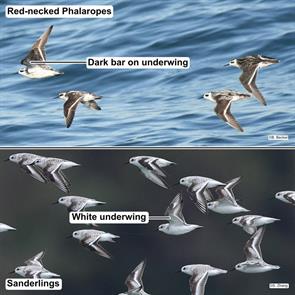
    Fig. 24. Red-necked Phalaropes and Sanderlings in the fall. Note black eye mask and darker streaky back and upper wings (mantle) on phalaropes. RNPH in Gulf of Maine, 23 August 2025; SAND at Parker River, 23 October 2023.
In this guide, we provide as much detail as possible to help identify this species. When discussing plumages, we use the terms winter, spring, and summer to refer to northern hemisphere temperate zone seasons. Because these birds spend parts of the year in the northern and southern hemispheres, the correct technical terms for the plumage stages—basic and alternate—help avoid the confusion of seasonal terminology.   
The plumage and molt sequence for Red-necked Phalarope is summarized below. Keep in mind that these birds show wide variation in plumage and molt sequence.
Basic: winter plumage, roughly November to March.
See Fig. 1.
Alternate: first spring and summer after hatch year or adult breeding plumage, March to June.
See Fig. 5, Fig. 7. Beginning in mid-March, winter (basic) feathers on Red-necked Phalarope are replaced by spring and summer (alternate) feathers. The molt back to basic plumage is well underway by July and continues throughout fall migration.
Juvenile: young birds, recently fledged, June to November.
See Fig. 14. These feathers are acquired immediately after the natal down is shed and before the young begin their migration. 
The smallest of the three phalarope species, Red-necked Phalarope nests in arctic and subarctic regions of the globe. Its wintering range is almost entirely oceanic. Due to the remoteness and relative inaccessibility of their breeding sites and, especially, their wintering grounds, Red-necked Phalaropes remain among the most enigmatic of shorebird species. Details of their courtship and nesting system, migration routes, molt patterns and nonbreeding distribution are still being puzzled out.
Like the closely related Red Phalarope, in North America Red-necked Phalarope migrates primarily through the western half of the continent and along the Pacific coast; however, many also migrate in spring and fall along the Atlantic coast. Oceanic storms during the months of passage, primarily May and August-September often result in “wrecks” of these birds in coastal New England and, sometimes, inland.
Red-necked Phalarope is pale gray on the upperparts in winter (basic) plumage. In spring, the female molts into eye-catching rufous, black, orange, gray and white plumage. The male in spring (alternate) plumage, though not as spectacular, is also much more colorful than his subtle, pale gray winter (basic) plumage.

Size and weight

The female is slightly larger and has a longer bill.
Body length:
7.25–7.5 in. (18–19 cm)
Wingspan:
12.25–16.25 in. (32–41 cm)
Bill length:
0.8–0.9 in. (21–23 mm)
Weight:
0.7–1.7 oz. (20–48 g)

Calls

Migrating flocks make a variety of squeaks or chirps.
Calls in Hella, Iceland, 7/10/2023:
Calls in Barrow, AK, 6/13/2017:

Plumage and other characteristics

Like other phalaropes, Red-necked Phalarope is thoroughly at home landing and feeding in water. Apart from the nesting season, most of its life is spent on open oceans worldwide.

Characteristic of the bird are its needle-thin, short, straight black bill, thin neck and small head; see Fig. 1, Fig. 2.

The three phalarope species have a shared feeding behavior in shallow waters: The birds spin rapidly, repeatedly pecking at the water surface. The spinning action stirs up organisms in lower water strata, thus bringing food items up to the surface to be consumed; see https://macaulaylibrary.org/asset/640723243.

Lobed toes are an adaptation for aquatic life. Phalarope toes are fringed by loose flaps of skin, which spread to provide forward motion in water; see Fig. 6.

Juvenile legs are pale—yellow or yellow-buff. As the juvenile matures, leg color darkens rapidly and become dark gray or bluish, like the adult, in October or November. Winter (basic) plumage is pale gray on the back (mantle). Each mantle feather has a very pale, thin margin. The face, crown and underparts are mostly white, with a gray wash on the lower chest and flanks. A black mask through the eye often curves slightly downward behind the eye; see Fig. 1, Fig. 2, Fig. 3. This plumage is unlikely to be seen in northern latitudes.

By late February or early March, Red-necked Phalaropes begin the molt to spring (alternate) plumage; see Fig. 4.

The female in breeding (alternate) plumage is by far the showier bird, sporting a black head with single white spot above the eye, rufous horseshoe wrapped around the neck, white chin and throat, dark gray back with orange-rufous stripes and mottled gray lower neck and flanks; see Fig. 5, Fig. 6.

The male in breeding plumage is a subdued version of the female. The corresponding black and dark gray feathers of the female are softer tones of brown on the male; see Fig. 7.

By midsummer, summer (alternate) plumage begins to be replaced by winter (basic) plumage. The slow molt continues throughout fall migration, unlike the other two phalarope species. This feature gives molting Red-necked Phalarope its characteristic, dark, streaked-back look; see Fig. 10, Fig. 11, Fig. 12, Fig 13.

After the breeding season, the adult Red-necked Phalarope loses its dark cap quickly and becomes mostly white headed; see Fig. 11, Fig. 12.

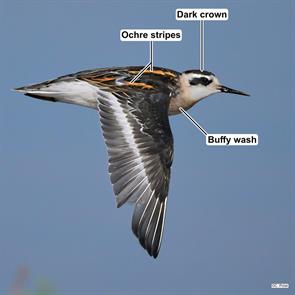
Fresh juvenile back (mantle) plumage is dark gray with striking ochre-orange stripes. The crown is blackish and remains so throughout the fall. The breast and flanks have a smudgy buffy wash; see Fig. 14, Fig. 15.

As fall advances, the ochre feather margins and buffy wash on the juvenile fade. Most fall juveniles are black, gray and white with a black crown and a black eye mask. Some keep hints of rufous on the mantle and neck. As with adults, they continue to molt throughout fall migration and, as a consequence, look streaky and dark on the head and mantle; see Fig 13, Fig. 16.

In flight, Red-necked Phalarope’s tail displays a dark center and pale gray edges; see Fig. 11, Fig. 17, Fig. 24.

Underwings of Red-necked Phalarope have a dark bar; see Fig. 6, Fig. 19, Fig. 24.

Red-necked Phalarope has a narrow, white upper wing stripe; see Fig. 20.

Breeding range, migration, wintering range, habitat

Red-necked Phalarope’s breeding range is circumpolar; it nests in low arctic and subarctic regions across all northern continents. In North America, the breeding range covers all of Alaska and most of northern Canada including Baffin Island, but not the northern Canadian archipelago. To the east of Hudson Bay, nesting occurs in northern Ungava, northern Quebec and the Labrador coast.

Red-necked Phalarope nests on the ground. Nesting habitat consists of tundra near fresh water lakes, bogs and marshes. Some nests are inland at higher elevations.

On the breeding grounds, females compete among one another for male selection. Once pairs have formed, copulation is often in the water; see Fig. 9.

The female lays a clutch of eggs, then leaves the male to incubate. Sometimes a female continues to court additional males and, occasionally, lay additional clutches.

The male alone incubates the eggs and spends a short time tending to the hatched chicks by brooding and guarding against predators.

Female Red-necked Phalaropes depart the nesting grounds around mid-June, followed about two weeks later by males. Juveniles follow somewhat later.

For several weeks in the summer, Red-necked Phalaropes that breed in the western half of North America congregate in vast numbers in staging areas in order to fatten up. Favored staging areas are saline or alkaline lakes and wetlands in Saskatchewan, British Columbia, Utah or California. These flocks, as well as others migrating through central North America or along the West Coast, end up in subtropical and tropical Pacific Ocean locations off the coast of Central America and Ecuador, Peru and Chile.

Eastern breeding Red-necked Phalaropes pass over Labrador in late summer and continue south along the east coast of North America. A population of two to three million were formerly observed in Bay of Funday during peak migration months, August and September. Beginning in the later 1980s, this population dropped drastically. It is not known whether these birds are now staging elsewhere; nor is it clear where they wintered in the past. As mentioned before, Red-necked Phalaropes are enigmatic.

Some Red-necked Phalaropes nesting in Greenland, Iceland and Scotland were tracked (using modern geolocating devices mounted on the birds) as they followed the east coast of North America, crossed over the Caribbean and Central America and ended up in the flocks that winter off western South America.

Other populations of Red-necked Phalarope, in northern Europe and Asia, winter in the Arabian Sea and off the coast of southeastern Asia.

Spring migration is largely coastal, though some western birds cut northeastward through California, Oregon or Washington to arctic breeding sites in central Canada. Western birds begin their northbound migration in mid-April.

Eastern birds in North America migrate northward along the coast in May and are sometimes blown ashore during intense storms.

Red-necked Phalaropes forage primarily while swimming, but they are also able to glean food from terrestrial vegetation while walking or wading.

When foraging in shallow water, phalaropes often spin around (reputedly only counterclockwise) to stir up food.

Major food items for nesting birds consist of copepods, aquatic fly larvae, beetles and spiders. At saline lakes during migration, the diet is primarily alkaline fly adults and larvae.

In pelagic environments during the winter, food consists of oceanic species such as copepods, euphausiids (krill), small crustaceans, insects and other marine invertebrates.

Similar species

Red-necked Phalarope compared to Red Phalarope

Red-necked Phalarope (RNPH) is slightly smaller than Red Phalarope (REPH). For comparison images, see Fig. 17, Fig. 18, Fig. 19, Fig. 20.

Note the following:

  • Red-necked Phalarope’s bill is needle-thin, pointed and black. Red Phalarope’s bill is thick and tubular; the base of the bill is usually pale.
  • In breeding (alternate) plumage, Red-necked Phalarope has a dark face and crown with a contrasting white chin. Red Phalarope has a dark cap, red or rufous-brown head and body and a white face.
  • Red-necked Phalarope molts throughout late summer and fall; during those seasons, adults and juveniles are streaked with dark gray on the back (mantle). Red Phalarope molts quickly in late summer and is mostly pale gray-backed during fall migration.
  • In flight, in all plumages, Red-necked has plain or steaked dark gray upper wings with narrow white stripes. Red displays a paler mantle with bolder white wing stripes.
  • Red-necked’s underwing has a dark bar in the center of the wing. Red Phalarope’s underwing is unmarked white.

Red-necked Phalarope compared to Wilson’s Phalarope

Red-necked Phalarope (RNPH) is considerably smaller than Wilson’s Phalarope (WIPH). Wilson’s is longer-necked and longer-legged. For comparison, see Fig. 21.

Note the following:

  • Red-necked and Wilson’s Phalaropes have needle-thin bills, but Wilson’s bill is much longer.
  • In late summer and fall, adult Red-necked Phalarope plumage is darker, contrasting sharply with white stripes on the back (mantle). Adult Wilson’s Phalarope, after the breeding season, molts rapidly, acquiring paler gray upperparts.
  • Juvenile Red-necked has a dark cap and blackish eye mask; the back (mantle) is streaked with dark and pale stripes. Juvenile Wilson’s has a gray cap and gray eye line; the mantle has scalloped patterning typical of juvenile sandpipers.
  • In winter (basic) plumage, Red-necked’s black eye mask sets it apart from Wilson’s with its gray eye line. Red-necked is usually darker on the mantle and retains some streaking on the back.
  • In breeding (alternate) plumage, Red-necked Phalarope is unmistakable: it has a dark gray back and crown with rufous wrapped around the neck, and orange or buff streaking on the back (mantle). Adult breeding Wilson’s black and rufous markings are on the sides of the neck; the crown is pale blue-gray.
  • Juvenile Red-necked has pale legs for a short time; legs become dark gray or bluish by mid-fall. Juvenile Wilson’s legs remain pale well into winter.
  • In flight, Red-necked Phalarope displays narrow white wing stripes and a dark-centered tail; Wilson’s has plain gray upper wings and a mostly pale tail.

Red-necked Phalarope compared to small peeps

Red-necked Phalarope (RNPH) is somewhat larger than Semipalmated Sandpiper (SESA) or Western Sandpiper; see Fig. 22.

Note the following:

  • The phalarope has a short, straight, needle-shaped bill compared to the thicker bill of either peep.
  • Early in life, juvenile Red-necked Phalarope’s legs are pale (yellowish), whereas Semipalmated Sandpiper and Western Sandpiper have dark legs.
  • In fall and winter, Red-necked Phalarope has a blackish eye mask, strongly contrasting with its white face. The peeps have brown or gray eye lines.
  • In fall, Red-necked Phalarope has a streaked back (mantle). In winter, the phalarope’s mantle becomes a pale gray. The fall and winter mantle on peeps is patterned (scalloped) gray-brown.

Red-necked Phalarope compared to Sanderling

Red-necked Phalarope (RNPH) is nearly identical in size to Sanderling (SAND). In breeding (alternate) plumage, there is almost no chance of confusing the two species. The phalarope is blackish on the head and back with orange back streaks, rufous wrapped around the neck and a needle-shaped bill. Sanderling is big-headed with a white belly, heavy rufous, black and brown speckling on the upperparts and head, and a thick, tubular bill; see Fig. 23.

During fall migration (and possibly during early spring migration) the similarity of the smaller phalaropes to Sanderling in flight is striking; see Fig. 24.

Note the following:

  • Red-necked Phalarope has a black eye mask. Sanderling’s black eye is centered on a pale face.
  • Juvenile Red-necked Phalarope has a blackish cap. Sanderling’s cap is a pale gray.
  • Red-necked Phalarope displays a streaked black-gray-white back (mantle). Sanderling’s mantle is speckled or checkered gray-and-white or just plain gray.
  • In flight, Red-necked Phalarope has a dark bar on the underwing. Sanderling’s underwing is white.
  • Red-necked Phalarope’s bill is needle-thin; Sanderling’s bill is heavier and blunt at the tip.

© Copyright 2026 Bird Observer, Inc. and Eric Swanzey.
Website code/design/development by Swanzey Internet Group LLC.
Supporting photography by Just Your Nature.
Privacy Policy | Terms of Use