Ruff

(Calidris pugnax) (RUFF)

Photographic Identification Guide

  • ruff.gauteng.south.africa.2024.01.08.olwen.sands.ML639700583.jpg
    0
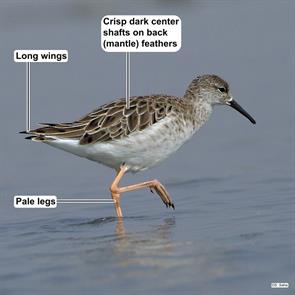
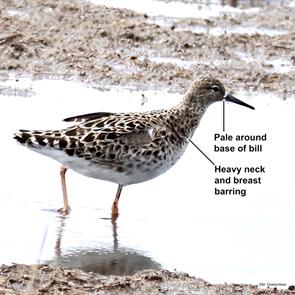
    Fig. 1. Ruff. Winter (basic) plumage. Note muddy pinkish legs, plump body. Gautang, South Africa. 8 January 2024.
  • ruff.gujarat.india.2023.01.13.subhankar.saha.ML639517780.jpg
    0
    Fig. 2. Ruff. Winter (basic) plumage. Note slightly curved bill with pale feathers at base. Gujarat, India. 13 January 2023.
  • ruff.daniel.webster.2024.04.07.eric.nielsen.328A5017.jpg
    0
    Fig. 3. Ruff. Young bird, first spring. Back (mantle) feathers appear long, loose and disheveled. Daniel Webster Sanctuary, Marshfield, MA. 7 April 2024.
  • ruff.daniel.webster.2024.04.07.eric.nielsen.328A5081.jpg
    0
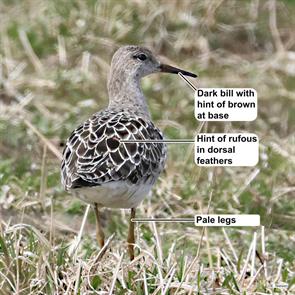
    Fig. 4. Ruff. Young bird, first spring. Rufous patch in dorsal feather indicates male. Daniel Webster Sanctuary, Marshfield, MA. 7 April 2024.
  • ruff.anahuac.20I4.05.05.MG_0342.jpg
    0
    Fig. 5. Ruff. Spring (alternate) plumage. Note a rusty tinge on the back (mantle) feathers indicating a male. Anahuac National Wildlife Refuge, TX. 5 May 2014.
  • ruff.plum.island.2024.05.06.margo.goetschkes.3Q6A6992.jpg
    0
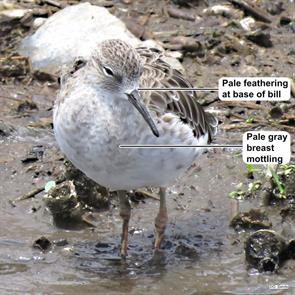
    Fig. 6. Ruff. Spring (alternate) plumage. Note pale feathering at base of bill, loose and fluffy back (mantle) feathers. Parker River National Wildlife Refuge, MA. 6 May 2024.
  • ruffs.brigantine.2024.06.26.b.elrick.finnmark.2025.06.03.anon.2025.06.21.l.gennari.Skåne.län.2025.06.24.s.menzie.jpg
    0
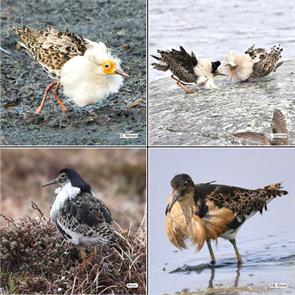
    Fig. 7. Ruff males in spring. The variety of display finery is bewildering. Bringantine, NJ, 24 June 2024; Finnmark, Norway, 3 June and 21 June 2025; Skåne län, Sweden, 24 June 2024.
  • ruffs.northern.ostrobothna.finland.2025.06.24.isaiah.nugent.ML638053081.jpg
    0
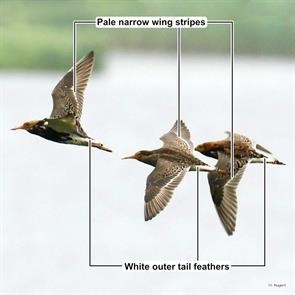
    Fig. 8. Ruffs males in flight. Northern Ostrobothnia, Finland. 24 June 2024.
  • ruff.pomorskie.poland.2025.06.27.gwiden.gaudnik.ML638233300.jpg
    0
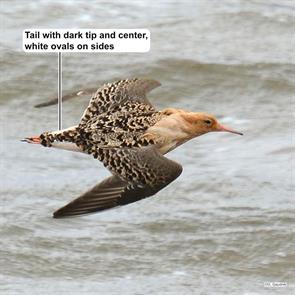
    Fig. 9. Ruff male in flight. White wing stripes may not display in this plumage. Pomorski, Poland. 27 June 2025.
  • reeve.finnmark.norway.2025.06.22.brett.sandercock.ML637929075.jpg
    0
    Fig. 10. Reeve (female Ruff). Breeding (alternate) plumage. Finnmark, Norway. 22 June 2025.
  • ruff.oslo.norway.2023.08.14.jon.andrea.kääb.ML639453361.jpg
    0
    Fig. 11. Ruff. Juvenile underparts, when fresh, are often buffy throughout. Oslo, Norway. 14 August 2023.
  • ruff.bear.creek.2014.10.28.IMG_6813.jpg
    0
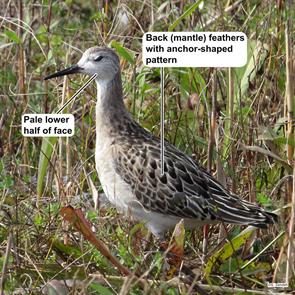
    Fig. 12. Ruff. Faded juvenile plumage with pale narrow margins. Mantle feathers with pale inner half and dark outer half give impression of anchor shapes. Bear Creek Sanctuary, Saugus, MA. 28 October 2014.
  • ruffs.sor-trondelag.norway.2025.08.03.harald.dahlby.ML639764979.jpg
    0
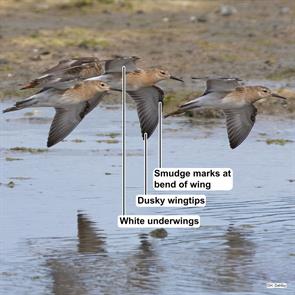
    Fig. 13. Ruff juveniles in flight. Gleaming white underwings contrast with buffy body. Sør-Trøndelag, Norway. 3 August 2025.
  • greater.yellowlegs.ruff.wilsons.phalarope.reifel.sanctuary.vancouver.2025.07.18.peter.candido.ML639082046.jpg
    0
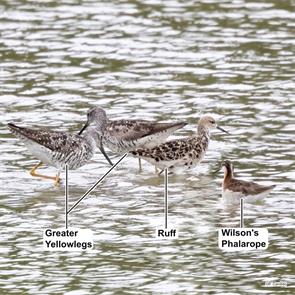
    Fig. 14. Comparison of Ruff with Greater Yellowlegs and Wilson's Phalarope. Reifel Bird Sanctuary, Vancouver, BC. 1 July 2025.
  • ruff.lesser.yellowlegs.dunlins.plum.island.2024.05.06.margo.goetschkes.3Q6A7027.jpg
    0
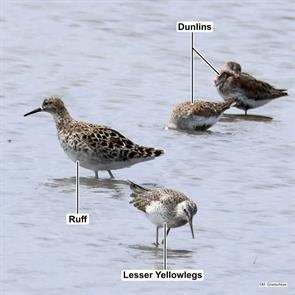
    Fig. 15. Comparison of Ruff with Lesser Yellowlegs and Dunlins. Male Ruff is larger than Lesser Yellowlegs. Parker River National Wildlife Refuge, MA. 6 May 2024.
  • reeve.suffolk.england.2025.07.31.peter.kennerley.ML639632810.buff-breasted.sandpiper.nahant.2016.09.02.jpg
    0
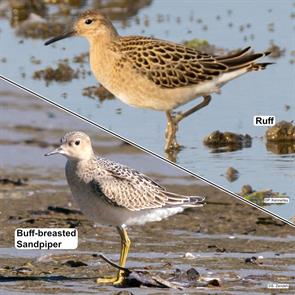
    Fig. 16. Comparison of female Reeve with Buff-breasted Sandpiper, both in juvenile plumage. Note differences in size, bill and leg color. RUFF Suffolk, England, 31 July 2025; BBSA Nahant, MA, 2 September 2016.
  • ruff.winthrop.beach.2025.07.01.chris.floyd..pectoral.sandpiper.bear.creek.2014.10.28.IMG_0073.jpg
    0
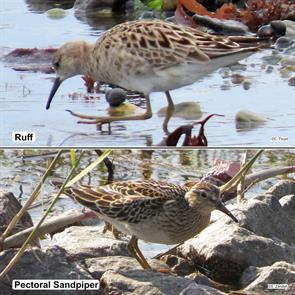
    Fig. 17. Comparison of Ruff with Pectoral Sandpiper. Note differences in size and breast pattern. RUFF Winthrop Beach, 1 July 2025; PESA Bear Creek, 28 October 2014.
  • ruff.killdeer.winthrop.beach.2025.07.01.chris.floyd.IMG_0093.jpg
    0
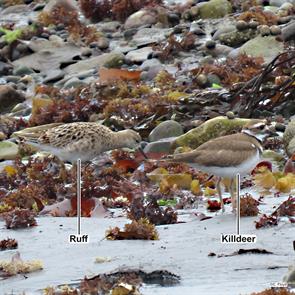
    Fig. 18. Compare size: Ruff is slightly chunkier than Killdeer. Reeve (female Ruff) is slightly smaller. Winthrop Beach, Winthrop, MA. 1 July 2025.
  • ruff.killdeer.winthrop.beach.2025.07.01.chris.floyd.IMG_0096.jpg
    0
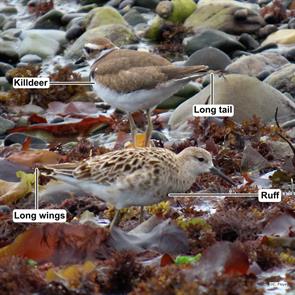
    Fig. 19. Ruff, a long-distance migrant, has longer wings than Killdeer, a short-distance migrant. Winthrop Beach, Winthrop, MA. 1 July 2025.
In this guide, we cover the features, in order of importance, to look for on these birds. When discussing plumages, we use the terms winter, spring, and summer to refer to northern hemisphere temperate zone seasons. Because most of these birds spend parts of the year in the northern and southern hemispheres, we also use the correct technical terms for the plumage stages—basic and alternate—to help avoid the confusion of seasonal terminology. 
Throughout the seasons, Ruff plumages are quite varied. With the exception of fully-ruffed males, distinguishing a juvenile from a female or a winter (basic) adult is tricky. The plumage descriptions below are general guides which may be difficult to apply in the field.
The photos in the album are arranged in this order:
Basic: winter plumage, roughly October to early March.
See Fig. 2. Male Ruffs molt to basic plumage beginning in midsummer. Nearly all birds are in full basic plumage by January.
Alternate: first spring and summer after hatch year or adult breeding plumage, March to July.
See Fig. 7, Fig. 8. In late February or early March, the molt to summer (alternate) plumage begins. The ruff and other decorations on the mature male start to grow by late April.
Juvenile: young birds, recently hatched, July to October.
See Fig. 11. These feathers are acquired on the breeding grounds immediately after the natal down is shed and before the young begin their southbound migration.
Ruff (Calidris pugnax) (RUFF) is an abundant breeder in northern palearctic areas of Europe and Asia. It appears in North America, including our region, with regularity. Males in breeding (alternate) plumage, with their flamboyant ruffs and wild head feathering, are unmistakable; see Fig. 7. Due to variability in plumage, females, juveniles, immatures and winter birds may be difficult to separate from other, more common North American shorebirds.
Ruff, like Buff-breasted Sandpiper, uses a lek in courtship. A lek is a shared display area where various males display for the benefit of females, known as Reeves. In the case of Ruff, each lekking male holds and defends a territory within the lek against other fully-ruffed, territorial males. Usually, pairs mate following encounters at a lek. But there are two other types of male that do not have territories—the satellite male and the female-look-alike. Ruff society has evolved to allow these other males also to access females for reproduction with little fanfare.
Unlike many other species of shorebirds, males do not participate in nest building, incubation or caring for chicks.

Size and weight

Males are approximately 20% larger than females.
Body length:
male 10.2–12.6 in. (26–32 cm)
female 7.9–9.8 in (20–25 cm)
Wingspan:
male 21.25–22.8 in. (54–58 cm)
female 18.9–20.5 (48–52 cm)
Bill length:
male 1.2–1.5 in. (31–39 mm)
female 1–1.3 in. (26–33 mm)
Weight:
2.5–6 oz. (70–170 g)

Calls

Ruff is not known to be as vocal as most other shorebirds. Its territorial and other calls consist mostly of grunts and squeaks.
Calls near Warsaw, Poland, 2016:
Calls in Saxony, Germany, 2014:

Plumage and other characteristics

Ruff male in breeding (alternate) plumage is unique among shorebirds. The variety of head tufts and ruffs on its neck and breast and the warty, bare facial skin make it unmistakable; see Fig. 7.

Throughout the seasons, Ruff plumages are extremely varied. Distinguishing juvenile from winter (basic) or female adult breeding (alternate) is not straightforward. The plumage descriptions below are general guides, which may be difficult to apply in the field. It is often necessary to use several features to identify this bird.

In seasons other than spring, most male Ruffs and female Reeves can be distinguished by a combination of plump body, longish neck, small head, short slightly downcurved bill and long pale legs; see Fig. 4, Fig. 6.

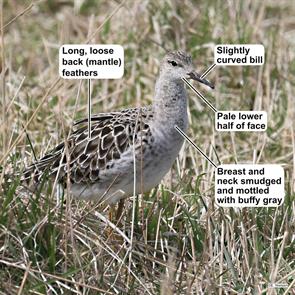
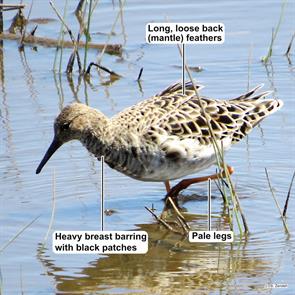
In most plumages, the back (mantle) feathers are long and loose, giving the bird a shaggy appearance; see Fig. 3, Fig. 5, Fig. 6.

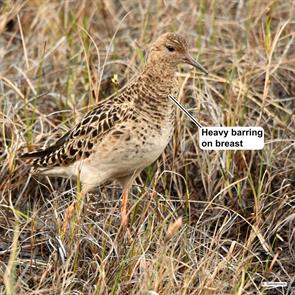
The breast is nearly always marked with buff, gray or brown bars. In winter, the barring may be pale and smudged; see Fig. 1, Fig. 3.

Some male Ruffs do not develop a ruff in spring, possibly due to being only one year old. In those birds and on adult Reeves during the breeding season, the neck and breast barring may be heavy; see Fig. 6, Fig. 10.

In fresh plumage, most juveniles have buffy underparts; see Fig. 11.

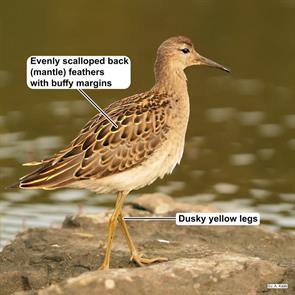
Juvenile back (mantle) feathers are pale at the base and blackish in the center, with broad and crisp pale margins. The dark portion of the feather sometimes has an anchor shape; see Fig. 11, Fig. 12.

In many plumages, particularly fall and winter, Ruff has a ring of whitish feathers at the base of the bill; see Fig. 1, Fig. 2, Fig. 6.

In winter (basic) plumage, most of the gray back (mantle) feathers show a crisp, dark center shaft line and pale narrow margins; see Fig. 2.

In most juveniles and winter (basic) birds, the lower half of the face is pale; see Fig. 3, Fig. 12.

The relatively long legs are pale and range widely in color: yellow, yellow-orange, pink, orange or dusky pale green; see Fig. 2, Fig. 4, Fig. 5, Fig. 11.

A long-distance migrant, Ruff is long-winged; folded wings often project past the tip of the tail; see Fig. 2, Fig. 19.

On an immature (one-year-old) male, some back (mantle) feathers show a touch of brown or rufous; see Fig. 4, Fig. 5.

Seen in flight from above, Ruff is mostly brown or gray-brown with pale narrow wing stripes; these stripes may not be conspicuous on males in full breeding finery. The tail is dark at the center with white, oval patches on the sides. The ovals may be merged near the tip of the tail; see Fig. 8, Fig. 9.

Seen in flight from underneath, the buffy pale or mottled body is set off by gleaming, mostly white underwings. Dark smudges or a comma pattern mark the bend of the wing. The wingtips are dusky; see Fig. 13.

Breeding range, migration, wintering range, habitat

The breeding range for Ruff covers a vast area of northern Eurasia: parts of northern Netherlands, Germany and Poland, most of Scandinavia and the Baltic states, all of northern Russia and Siberia, as well as scattered locations in mid-latitude Russian plains.
Ruff males require a lekking area to display for potential mates. The breeding habitat for the species, therefore, must include adjacent areas for the lek, feeding and nesting. This includes areas of coastal tundra or forest tundra adjacent to lakes, marshes or swampy meadows.
The male Ruff plays no role in nest building or care of the young. The female Reeve apparently is nearly as polyandrous as the male is polygamous. She selects a nest site in a solitary or semi-colonial setting concealed in marsh plants or meadow grasses.
Ruff chicks are precocial and begin running about and foraging for food soon after hatching. The female cares for chicks by brooding them until they are close to fledging, when she departs on migration.
Wintering Ruffs are found throughout the southern two-thirds of Africa; other large concentrations are along the southern shores of western, southern and southeast Asia. Small numbers winter in England, coastal France and central Spain. The wintering habitat includes margins of brackish, saline or alkaline swamps, rice fields or mudflats.
In New England, Ruffs have appeared most often in coastal locations in spring; there are several late summer or fall records as well.
Aquatic and terrestrial insects are the main food for Ruff during the breeding season. During migration and on wintering grounds, the diet is more varied. The insect diet may be supplemented with aquatic and marine crustaceans, mollusks, worms, frogs and small fish, along with rice and other cereals, sedges, grasses and aquatic plants.

Similar species

Ruff compared to Greater Yellowlegs

The male Ruff (RUFF) is somewhat smaller than Greater Yellowlegs (GRYE). The female Reeve is considerably smaller than Greater Yellowlegs. For a comparison image, see Fig. 14.

Note the following:

  • In most plumages, Ruff is browner than Greater Yellowlegs.
  • Ruff’s bill is considerably shorter than Greater Yellowlegs’ bill. It is slightly downcurved, whereas Greater Yellowlegs’ bill is straight or slightly upturned.
  • Ruff’s head and face are often paler than the back (mantle); in many individuals the lower half of the face is nearly white. Greater Yellowlegs’ face is gray with a bold dark line from the bill back through the eye and a prominent white eye ring.
  • Yellowlegs have bright yellow legs during all seasons. Ruff’s leg color varies greatly depending on season, age and sex; its legs can be yellow, dusky yellow, yellow-orange, orange, pink or greenish.
  • Ruff’s back (mantle) feathers are large and loose with pale narrow margins; the bird usually has a scalloped pattern on the mantle. Greater Yellowlegs in breeding (alternate) plumage has a checkered black-and-white pattern on the mantle. During molt, the back takes on an uneven salt-and-pepper pattern. In juvenile and winter (basic) plumage, Greater Yellowlegs’ back is gray-brown evenly spotted with white.
  • Ruff underparts plumage is varied; the upper belly, breast and neck usually show thick, smudgy black or brown barring, sometimes spotting. In winter, the barring becomes worn and faded. Greater Yellowlegs in breeding (alternate) plumage has narrow, crisp barring on the underparts. In winter (basic) plumage, Greater Yellowlegs is finely streaked with gray on the neck and upper breast with a white lower breast and belly.
  • Folded wings on Ruff, a long-distance migrant, frequently project beyond the tail. Greater Yellowlegs’ wingtips are usually even with the end of the tail.
  • Greater Yellowlegs, sometimes when on the ground and often when flying, emits a resonant tyo-oo call, repeated 3 or more times. Ruff is generally silent; it may emit a grunt when flying off.
  • In flight, Ruff usually has a pale narrow wing stripe and bold white ovals on the sides of the dark-centered tail. Greater Yellowlegs wings are unmarked gray; the tail is white, gray-barred near the end.

Ruff compared to Lesser Yellowlegs

The male Ruff (RUFF) is considerably larger than Lesser Yellowlegs (LEYE). The female Reeve is about the same size as Lesser Yellowlegs. For a comparison image, see Fig. 15.

Note the following:

  • In most plumages, Ruff is browner than Lesser Yellowlegs.
  • Ruff’s bill is thick and slightly downcurved, whereas Lesser Yellowlegs’ bill is slim and straight.
  • Ruff’s head and face are often paler than the back (mantle); in many individuals the lower half of the face is nearly white. Sometimes there is a ring of white feathers at the base of the bill. Lesser Yellowlegs’ face is gray with a bold dark line from the bill back through the eye, and a prominent white eye ring.
  • Yellowlegs has legs that are bright yellow during all seasons. Ruff’s leg color varies greatly depending on season, age and sex: yellow, dusky yellow, yellow-orange, orange, pink or greenish.
  • Ruff’s back (mantle) feathers are large and loose with pale narrow margins; the bird usually has a scalloped pattern on the mantle. Lesser Yellowlegs in breeding (alternate) plumage has a checkered black-and-white pattern on the mantle. During molt, the back takes on an uneven salt-and-pepper pattern. In juvenile and winter (basic) plumage, Lesser Yellowlegs has a gray-brown back evenly spotted with white.
  • Ruff’s underparts plumage is varied; the upper belly, breast and neck usually consist of thick, smudgy black or brown barring, sometimes spotting. In winter, the barring becomes worn and faded. Lesser Yellowlegs in breeding (alternate) plumage has narrow, crisp barring on the underparts. In winter (basic) plumage, Lesser Yellowlegs is finely streaked with gray on the neck and upper breast with a white lower breast and belly.
  • A long-distance migrant, Ruff’s folded wings frequently project beyond the tail. Lesser Yellowlegs’ wingtips are usually even with the end of the tail.
  • Lesser Yellowlegs has a distinctive tu-tu call, repeated two or three times. Ruff is generally silent; it may emit a grunt when flying off.
  • In flight, Ruff usually has a pale narrow wing stripe and bold white ovals on the sides of the dark-centered tail. Lesser Yellowlegs wings are unmarked gray, and the tail is white, gray-barred near the end.

Ruff compared to Buff-breasted Sandpiper

Ruff (RUFF) is about one and a half times the size of Buff-breasted Sandpiper (BBSA). A buffy juvenile Ruff may be confused with Buff-breasted Sandpiper; see Fig. 16.

Note the following:

  • Ruff’s bill is often slightly downturned. Buff-breasted Sandpiper’s bill is short and straight.
  • Buff-breasted Sandpiper’s legs are bright yellow. Ruff’s leg color varies greatly depending on season: yellow, dusky yellow, yellow-orange, orange, pink or greenish.
  • In fall, when both birds in juvenile plumage are likely to be seen in New England, Ruff’s back (mantle) plumage is evenly scalloped; each feather has a pale base and dark center set off by a crisp pale margin. Buff-breasted’s scapular and upper back feathers are similarly scalloped, but its lower wing coverts are paler and have more complicated patterning; there is a dark submarginal line bordering the pale margin of each feather.
  • In flight, Ruff usually has a pale narrow wing stripe and bold white ovals on the sides of the dark-centered tail. Buff-breasted Sandpiper has brown upperwings and tail with no prominent pale markings.

Ruff compared to Pectoral Sandpiper

Ruff (RUFF) is at least 20% larger than Pectoral Sandpiper; see Fig. 17.

Note the following:

  • Ruff’s breast is usually barred in a smudgy manner or marked with uneven spots. Pectoral Sandpiper’s neck and upper breast are neatly streaked. The streaking ends abruptly on the lower breast, biblike.
  • Pectoral Sandpiper’s head and face are streaked gray-brown with a bold eye-brow line. Ruff has variable facial markings; juvenile and winter birds are often pale on the lower half of the face.
  • Ruff’s bill may show a bit of pale brown or pink at the base. Pectoral Sandpiper’s bill is nearly always two-toned, with a pale base and dark tip.
  • Ruff’s back (mantle) plumage is often long and loose, appearing somewhat shaggy. Pectoral Sandpiper plumage is neatly arranged.

Ruff compared to Killdeer

Female Reeve is nearly identical in size to Killdeer; male Ruff is slightly larger. Although there are few similarities between Ruff (RUFF) and Killdeer (KILL), the similarity in size may be useful when direct comparison is possible; see Fig. 18, Fig. 19.

© Copyright 2026 Bird Observer, Inc. and Eric Swanzey.
Website code/design/development by Swanzey Internet Group LLC.
Supporting photography by Just Your Nature.
Privacy Policy | Terms of Use