Wilson's Snipe

(Gallinago delicata) (WISN)

Photographic Identification Guide

  • wilsons.snipe.goose.bay.labrador.2025.07.19.vernon.buckle.ML639232271.jpg
    1
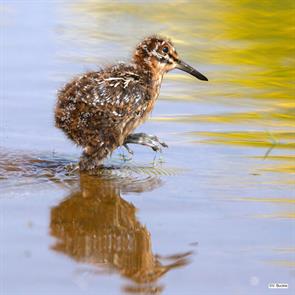
    Fig. 1. Wilson's Snipe. Chick. Note short bill, huge feet, richly colored, cryptic downy plumage. Goose Bay, Labrador, Canada. 19 July 2025.
  • wilsons.snipe.fairbanks.ak.2024.07.05.d.gamelin.ML621190559.jpg
    1
    Fig. 2. Wilson's Snipe. Nearly fully-grown chick. Plumage of torso is very similar to adult. Face and head striping comes later. Fairbanks, AK. 5 July 2024.
  • wilsons.snipes.slope.nd.2025.06.26.mark-holly.salvato.ML639307200.jpg
    0
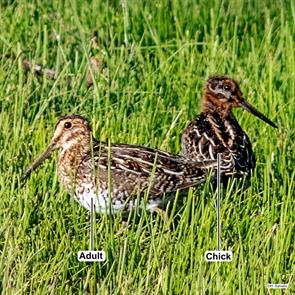
    Fig. 3. Wilson's Snipes. Adult tends to chick, including feeding, far longer than most shorebirds. Slope, ND. 26 June 2025.
  • wilsons.snipes.hornsby.bend.2022.01.22.P2980410.jpg
    0
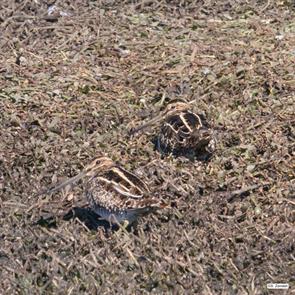
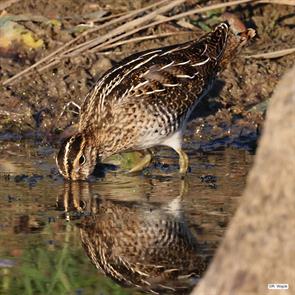
    Fig. 4. Wilson's Snipes. Perfect camouflage for winter vegetation. Hornsby Bend, Austin, TX. 22 January 2022.
  • wilsons.snipe.erie.pa.2025.10.04.john.kramer.ML643077068.jpg
    0
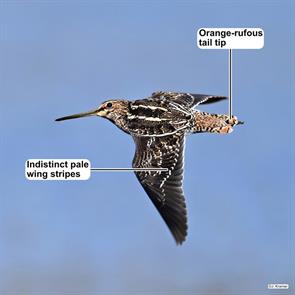
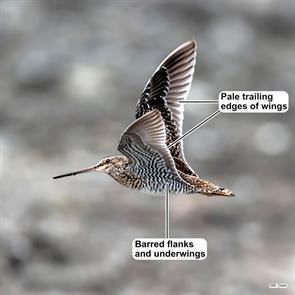
    Fig. 5. Wilson's Snipe in flight. Short tail is paler and more colorful than the dark back (mantle). Erie, PA. 4 October 2025.
  • wilsons.snipe.kawartha.lakes.on.2024.06.22.toby.rowland.ML641530516.jpg
    0
    Fig. 6. Wilson's Snipe. Note streaked face and back (mantle). Kawartha Lakes, Ontario, Canada. 22 June 2024.
  • wilsons.snipe.bear.creek.2025.03.30.matt.clark.DSC00898.jpg
    0
    Fig. 7. Wilson's Snipe in flight. Note short tail and boldly patterned body. Bear Creek Sanctuary, Saugus, MA. 30 March 2025.
  • wilsons.snipes.fort.george.bc.2025.07.19.jeff.dyck.ML639160038.jpg
    0
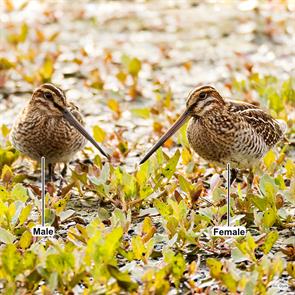
    Fig. 8. Wilson's Snipes. Female snipe's bill is noticeably longer. Fort George, British Columbia, Canada. 19 July 2025.
  • wilsons.snipe.la.vallée-de-l'or.quebec.2025.07.05.francois.hamel.ML638492171.jpg
    0
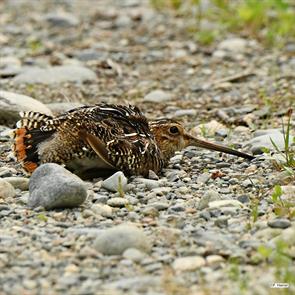
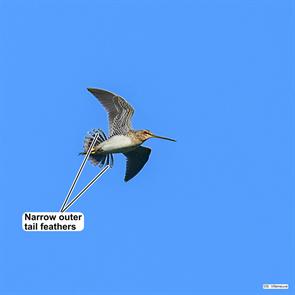
    Fig. 9. Wilson's Snipe distraction display. Note plain, narrow, barred outer tail feathers. La Valée-de-l'Or, Quebec, Canada. 5 July 2025.
  • wilsons.snipe.la.côte-de-beaupré.quebec.2025.06.30.simon.villeneuve.ML638419668.jpg
    0
    Fig. 10. Wilson's Snipe territorial display. In flight, flared outer tail feathers vibrate to produce characteristic winnowing sound. La Côte-de-Beaupré, Quebec, Canada. 30 June 2025.
  • wilsons.snipe.westmoreland.nb.2025.10.05.jason.gallant.ML643002688.jpg
    0
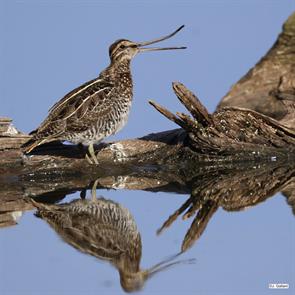
    Fig. 11. Wilson's Snipe. As with most sandpipers, the bill is soft and flexible. Westmoreland, New Brunswick, Canada. 5 October 2025.
  • wilsons.snipe.santa.clara.ca.2025.10.06.david.zittin.ML643059428.jpg
    1
    Fig. 12. Wilson's Snipe. Intricately patterned plumage remains relatively unchanged throughout the year. Santa Clara, CA. 6 October 2025.
  • wilsons.snipes.benton.or.2025.10.03.cory.walker.ML643174556.jpg
    0
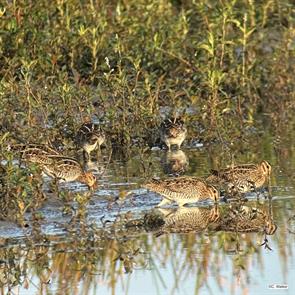
    Fig. 13. Wilson's Snipes. Though mostly solitary, snipes feed communally where food is plentiful. Benton, OR. 3 October 2025.
  • wilsons.snipe.lake.il.2025.10.07.rick.wojcik.ML643116326.jpg
    0
    Fig. 14. Wilson's Snipe feeding with its bill deeply inserted in the water and mud. Lake, IL. 7 October 2025.
  • wilsons.snipe.ottawa.ontario.2025.10.13.fang-shuo.hu.ML643443072.shoirt-billed.dowitcher.winthrop.2014.08.07.IMG_3728.jpg
    0
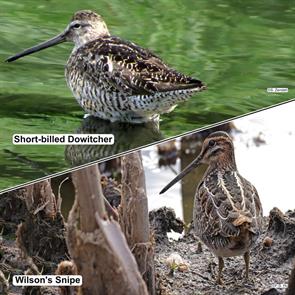
    Fig. 15. Comparison of Wilson's Snipe with Short-billed Dowitcher. Note bold striping on the snipe’s head and back (mantle). WISN in Ottawa, Ontario, Canada. 12 October 2025; SBDO in Winthrop, MA. 7 August 2014.
  • wilsons.snipe.sarasota.fl.2018.02.26.larry.masters._Q0I4147c.american.woodcock.acadia.2025.09.10.anon.ML642768017.wisn.jpg
    0
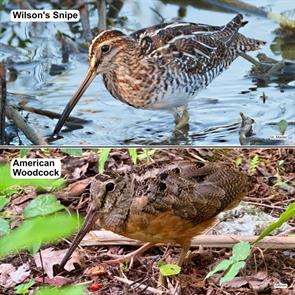
    Fig. 16. Comparison of Wilson's Snipe with American Woodcock. Head stripes are front to back on snipes, side to side on woodcocks. WISN in Sarasota, FL. 26 February 2018; AMWO in Acadia National Park, ME. 10 September 2025.
  • wilsons.snipe.lesser.yellowlegs.arl.res.2021.10.08.P2910067.jpg
    0
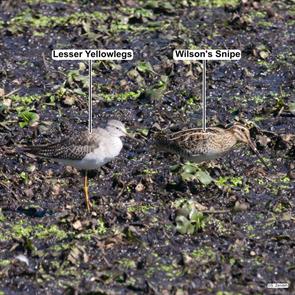
    Fig. 17. Comparison of Wilson's Snipe with Lesser Yellowlegs. Note eye placement relatively high on the snipe's face. Arlington Reservoir, Arlington, MA. 8 October 2021.
In this guide, we provide as much detail as possible to help identify this species. The molt sequence for Wilson’s Snipe barely follows the usual pattern for most shorebirds; throughout the seasons, most Wilson’s Snipe plumages after the downy stage are similar. It is, therefore, difficult to age an individual Wilson’s Snipe without close examination of the plumage. The plumage and molt sequence are summarized below.
Chick: newly hatched bird is precocial, a fluffball of rufous, tan, chestnut brown and black with big feet.
See Fig. 1.
Juvenile: a short-lived transition plumage.
See Fig. 2.
Adult: feathers acquired after juvenile plumage.
See Fig. 12.
Wilson’s Snipe, a common and widespread sandpiper in North America, is a game bird with a bag limit in many localities; for example, the Massachusetts bag limit is eight birds. It is wary and hard to see, primarily because of its cryptic coloration. Often, the first time it is seen is when it pops out of a marsh or muddy spot with its characteristic, hoarse scaipe call, flying away rapidly with frequent twists and turns.

Size and weight

Females are longer billed.
Body length:
10–11.5 in. (25–28 cm)
Wingspan:
17.25–19.5 in. (43–48 cm)
Bill length:
male 2.2–2.7 in. (55–69 mm)
female 2.2–2.8 in. (57–72 mm)
Weight:
2.8–5.2 oz. (79–146 g)

Calls

These are some characteristic calls or songs of Wilson’s Snipe.
Winnowing, Lotbinière, Quebec, Canada, 5/20/2025:
Contact and warning calls, Kawartha Lakes, Ontario, Canada, 5/20/2023:
Scaipe flight warning call, Brevard Co, FL. 11/11/2016:

Plumage and other characteristics

Wilson’s Snipe is usually detected when it abruptly erupts from its grassy or swampy habitat and flies away, twisting and turning. Then it lands in grass or reeds and instantly disappears. The characteristic grating, raspy scaipe call is emitted as the bird flies away.

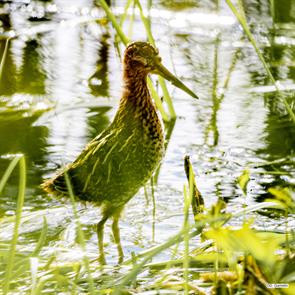
Wilson’s Snipe’s plumage often blends in perfectly with vegetation; see Fig. 4.

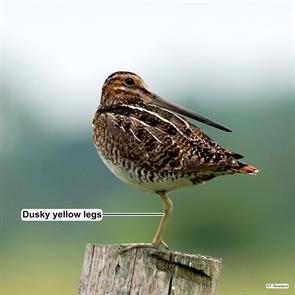
Wilson’s Snipe, if seen well on the ground or on a post, is usually unmistakable: it has a rounded, chunky body with bold, pale, parallel streaks on the back (mantle), dark parallel lines on the face and crown, a very long bill and a short tail; see Fig. 6, Fig. 12.

In flight, Wilson’s Snipe displays pale parallel streaks on the mantle. The wings are dark with indistinct stripes and spots. The rump is tan or buffy and the tail tip is bright orange rufous. Underwings and flanks are heavily barred. The trailing edges of the wings are pale; see Fig. 5, Fig. 7.

During the nesting season, male (primarily) and female winnow, often at dusk or dawn. Winnowing is a haunting, ethereal sound made by air rushing over the spread and vibrating outer tail feathers during flight; see Fig. 10. Listen also: https://xeno-canto.org/1012875. The sound is made by birds flying fairly high overhead. Frequently, due to low light conditions, the birds are invisible.

Wilson’s Snipe’s chick is a maroon, tan and pale fluffball with large feet. The bill is thick and slightly longer than the head. It is precocial, running about shortly after emerging from the egg; see Fig. 1.

When partially grown, the chick molts rapidly. Torso down is shed and replaced with feathers resembling the adult. Upper breast, neck and head plumage retains the dark, mottled look of the chick for several more months; see Fig. 2, Fig. 3.

Once Wilson’s Snipe grows its first adult feathers in June or July, its appearance barely changes over the seasons. Juveniles may be distinguished by broader and buffier margins on feathers of the neck, back, scapulars and wing coverts. Also, the juvenile’s rump is buffier. These plumage details are often difficult to distinguish in a bird as cryptic as Wilson’s Snipe.

Wilson’s Snipe’s bill is dark brown at the tip, reddish brown or tan at the base. The female has a longer bill; see Fig. 8.

As with many sandpipers, Wilson’s Snipe’s bill is soft and flexible. When the bill is inserted into mud or other soft substrate, the bird can flex the tip of the bill open to grasp prey; see Fig. 11.

Breeding range, migration, wintering range, habitat

Slightly larger than an American Robin, Wilson’s Snipe may be common in fields and wet meadows but is usually difficult to see before it flushes, turning and twisting while flying away.

Wilson’s Snipe is widespread, nesting from coast to coast throughout northern North America except for far northern Canada and the Canadian Arctic archipelago.

Wilson’s Snipes are early spring migrants. Males usually arrive in New England by late March or early April, about ten days to two weeks ahead of females.

Shortly after arrival at a nesting site, a female is courted by and copulates with several males.

Wilson’s Snipes briefly form monogamous pair bonds once the young hatch and need care and feeding.

Wilson’s Snipe’s nest, unusually elaborate for a shorebird, is woven of coarse and fine grasses. It is located in a scrape on the ground.

When disturbed at the nest, Wilson’s Snipe performs a distraction display; see Fig. 9.

Nest formation, egg laying and incubation by females occur throughout May and into June. A male Wilson’s Snipe may brood eggs or tend to young briefly if the female is absent.

Once partially grown, half the chicks often leave the nest with the male, the other half with the female. The split-up family apparently does not reconnect.

Unlike many other shorebirds, adults feed the young initially and continue tending to and feeding them for several weeks while the chicks learn to forage on their own; see Fig. 3.

Fall migration begins with the juveniles leaving nesting areas in August, followed by females, then males. Southbound migration usually lasts until November.

Wilson’s Snipe migrates at night. Fall migration is along a broad front. Many birds from northeastern United States and eastern Canada fly over the ocean to the Caribbean archipelago (West Indies).

The winter range extends south into Mexico, Central America, the Caribbean archipelago and northern South America.

In winter, snipes don’t always remain in one region. There is evidence of long-distance movements of snipes among different southern wintering spots.

Throughout its range and during all seasons, Wilson’s Snipe’s food consists primarily of larval insects, supplemented by small crustaceans, earthworms and mollusks; some plant material is also ingested.

A snipe feeds by inserting its long bill into water or mud and probing for food, which it can grasp with its prehensile, soft bill; see Fig. 11, Fig. 13, Fig. 14.

Similar species

Wilson’s Snipe compared to dowitcher

Wilson’s Snipe (WISN) is similar in shape to Short-billed Dowitcher (SBDO) and Long-billed Dowitcher (LBDO) and is slightly smaller than either. For a comparison with Short-billed Dowitcher, see Fig. 15.

Note the following:

  • Wilson’s Snipe’s crown and face are boldly marked with dark brown stripes. Dowitcher’s face markings and crown are paler and less distinct.
  • Wilson’s Snipe’s back (mantle) has strong parallel pale stripes. Dowitcher’s mantle is speckled gray, brown, black and white, depending on the season.
  • In all seasons, Wilson’s Snipe’s plumage is a colorful pattern of rufous, white and blackish. The head and tail, in particular, have a mixture of rufous and orange. Dowitchers in winter (basic) plumage are a dull gray on the back (mantle), becoming more colorful with spring and summer (alternate) plumage.
  • In all seasons, Wilson’s Snipe is white on the belly, heavily barred on the flanks, and streaked on the neck and upper breast. Alternate-plumaged dowitchers are orange or rufous on the belly, breast and neck.
  • With its eyes placed high and toward the back of the head, Wilson’s Snipe is adapted for feeding in dark, swampy locations and burying its bill and part of its head in water. Although dowitchers often feed in the same way, the position of the eye is not as extreme.
  • Wilson’s Snipe is found primarily in freshwater habitats throughout North America. Short-billed Dowitcher is usually found in coastal saltwater locations in our region. Long-billed Dowitcher is more likely in fresh water.
  • When flushed, the snipe emits a guttural scaipe as it zigzags away. Short-billed Dowitcher has a clucking tu-tu and flies straight. Long-billed Dowitcher has a high-pitched kik and also flies straight.
  • In New England, Wilson’s Snipe arrives from southern wintering areas in late March. During the nesting season, from May until at least July, snipes are usually present in the western half of Massachusetts and in northern New England. Snipes depart the region in October or November; a few may winter locally in warmer spots, particularly along the coast of southern New England.
  • Some dowitchers may arrive in New England in March, but the bulk of migrants in our region, primarily Short-billed, arrive in May and depart quickly for nesting areas in northern Canada. Their fall migration brings them here in July; some may stay until October. Most are gone by November, with a few occasionally wintering in coastal or warmer locations.

Wilson’s Snipe compared to American Woodcock

Wilson’s Snipe (WISN) and American Woodcock (AMWO) are long-billed, cryptic-plumaged creatures of woods, swamps or heavily vegetated wetlands; see Fig. 16.

Note the following:

  • Wilson’s Snipe is slightly longer; American Woodcock is chunkier and rounder.
  • Wilson’s Snipe is barred and streaked, imitating grasses and vegetation. The predominant feature of American Woodcock is cryptic or camouflage plumage, imitating dead leaves.
  • Snipe’s head and face are marked with parallel dark and light stripes front to back. Woodcock’s crown is barred with two broad, dark stripes side to side.
  • Snipe is heavily barred on the flanks; the belly is white. Woodcock is rufous-orange on the belly.
  • Snipe is often found in water or muddy swamps. Woodcock’s habitat is mostly woods or wooded swamps.

Wilson’s Snipe compared to yellowlegs

Wilson’s Snipe (WISN) is roughly the size of Lesser Yellowlegs (LEYE) and much smaller than Greater Yellowlegs (GRYE). For a comparison to Lesser Yellowlegs, see Fig. 17.

Note the following:

  • Wilson’s Snipe’s bill is very long and tubular with a dark outer half and paler base. The bill on both yellowlegs is tapered. Lesser Yellowlegs’ bill is short, black and fine-tipped. Greater Yellowlegs’ bill is long and dark with a pale base.
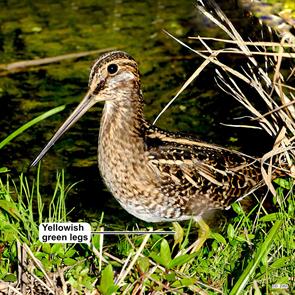
  • Wilson’s Snipe’s short legs are dusky yellow. The legs on both yellowlegs are long and bright yellow.
  • Wilson’s Snipe’s head and back (mantle) are boldly streaked. The overall coloration is brown, rufous-orange and white. Yellowlegs have gray heads and are speckled or checkered on the mantle. The overall coloration is gray and white.
  • Wilson’s Snipe’s neck and upper breast are heavily patterned with brown and white streaks. Yellowlegs in breeding (alternate) plumage have medium-heavy gray and white patterning on the neck and upper breast. In juvenile and winter (basic) plumage, yellowlegs’ neck and upper breast are lightly streaked or mottled with pale gray.
  • Wilson’s Snipe’s eye placement is high on the head. Yellowlegs’ eyes are located more centrally on the face.

© Copyright 2026 Bird Observer, Inc. and Eric Swanzey.
Website code/design/development by Swanzey Internet Group LLC.
Supporting photography by Just Your Nature.
Privacy Policy | Terms of Use