Spotted Sandpiper

(Actitis macularius) (SPSA)

Photographic Identification Guide

  • spotted.sandpiper.lyann.comrack.2006.01.22.san.diego.ca.ML632930348.jpg
    0
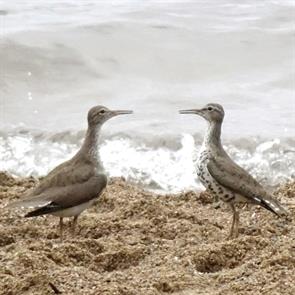
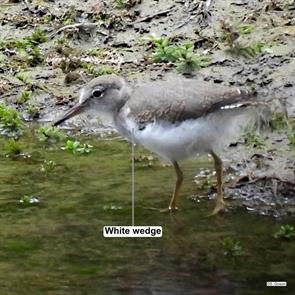
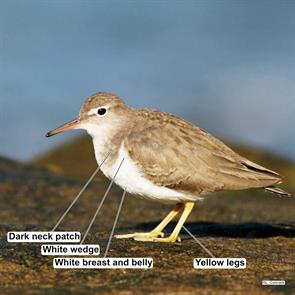
    Fig. 1. Spotted Sandpiper. Winter (basic) plumage. Note long tail, pale legs and pale wedge separating brown wings from brown neck patch. San Diego, CA. 22 January 2006.
  • spotted.sandpiper.tyne.and.ware.england.uk.2018.10.21.jonathan.farooqi.ML432925141.jpg
    0
    Fig. 2. Spotted Sandpiper. Winter (basic) plumage. Note plain gray-brown back (mantle) feathers with crisp, dark center shafts. Tyne & Ware, England, UK. 21 October 2018.
  • spotted.sandpiper.bolivar.2019.05.06.P2300164.jpg
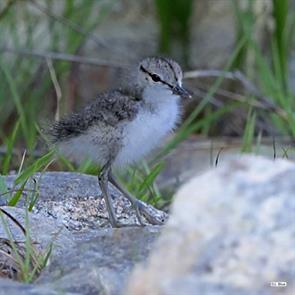
    0
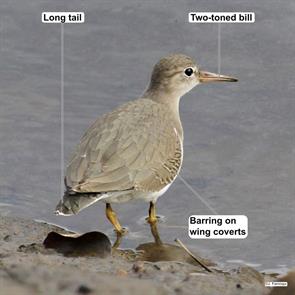
    Fig. 3. Spotted Sandpiper. Spring (alternate) plumage. Note two-toned bill, long tail. Bolivar Peninsula, TX. 6 May 2019.
  • spotted.sandpiper.katmai.np.ak.2008.06.21.larry.master._MG_4236c.jpg
    0
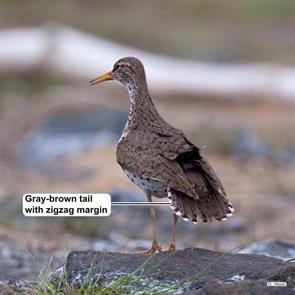
    Fig. 4. Spotted Sandpiper. Note pattern of spread tail. Katmai National park, AK. 21 June 2008.
  • spotted.sandpiper.routt.co.2020.05.24.noah.brinkman.ML633789810.jpg
    0
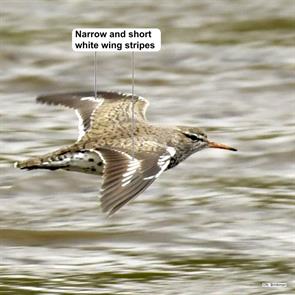
    Fig. 5. Spotted Sandpiper. Spring (alternate) plumage, in flight. Wing beats during short flights are stiff and jerky. Routt, CO. 24 May 2020.
  • spotted,sandpiper.bartlet.mall.park.essex.ma.2024.07.21.davey.walters.ML621719369.jpg
    0
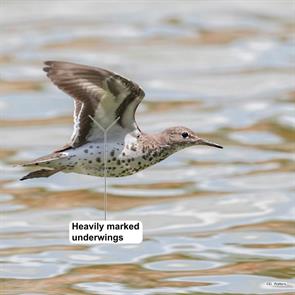
    Fig. 6. Spotted Sandpiper. In flight, underwings are marked with parallel light and dark stripes. Essex, MA. 21 July 2024.
  • spotted.sandpipers.lake.massapoag.ma.2023.07.16.em.ganin.ML594536351.jpg
    0
    Fig. 7. Spotted Sandpipers. Females in territorial confrontation. Lake Massapoag, Sharon, MA. 16 July 2023.
  • spotted.sandpipers.katmai.np.ak.2008.06.21.larry.master._MG_4221c.jpg
    0
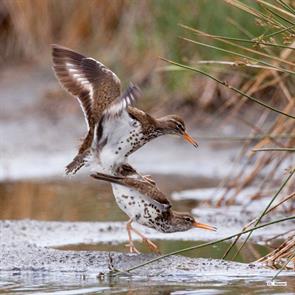
    Fig. 8. Spotted Sandpipers copulating. Note pinkish or orange legs and bill. Katmai National Park, AK. 21 June 2008.
  • spotted.sandpiper.quabbin.ma.2022.07.01.julie.blue.ML474002321.jpg
    0
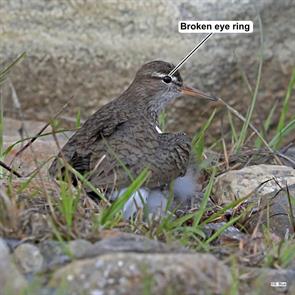
    Fig. 9. Spotted Sandpiper male incubating downy chick(s). Quabbin, MA. 1 July 2022.
  • spotted.sandpiper.quabbin.ma.2022.07.01.julie.blue.ML474002291.jpg
    0
    Fig. 10. Spotted Sandpiper. Newly hatched chick. Quabbin, MA. 1 July 2022.
  • spotted,sandpiper.bartholomews.cobble.ashley.falls.ma.2024.07.22.susan.gowen.ML620717665.jpg
    0
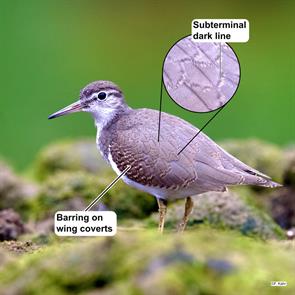
    Fig. 11. Spotted Sandpiper. Partially grown chick begins to display some adult characteristics. Note two-toned bill, barred wing coverts. Ashley Falls, MA. 22 July 2024.
  • spotted.sandpiper.taylors.pond.barnstable.ma.2022.07.24.frank.kahr.ML469966541.jpg
    0
    Fig. 12. Spotted Sandpiper. Fresh juvenile plumage. Note back (mantle) feather details, bold pale eyebrow and eye ring, wedge of white on side of breast. Taylors Pond, Barnstable, MA. 24 July 2022.
  • spotted.sandpiper.choco.colombia.2024.08.14.alberto.acero.ML631461552.jpg
    0
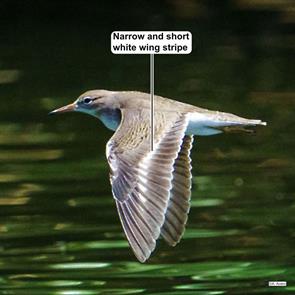
    Fig. 13. Spotted Sandpiper. Juvenile in flight. Note conspicuous dark-and-light barring on upper wing coverts, unmarked belly and breast. Choco, Colombia. 14 August 2024.
  • solitary.sandpiper.spotted.sandpiper.horn.pond.woburn.ma.2024.07.13.jeffrey.thomas.ML621652429.jpg
    0
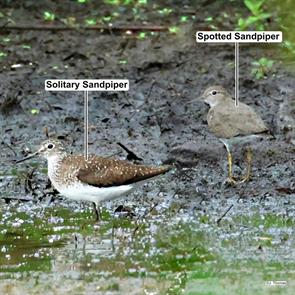
    Fig. 14. Comparison of Spotted Sandpiper with Solitary Sandpiper. Note Spotted back (mantle) of Solitary vs. relatively plain brown mantle of Spotted. Horn Pond, Woburn, MA. 13 July 2024.
  • spsa.taylors.pond.barnstable.ma.2022.07.24.frank.kahr.ML469966541.cosa.zeeland.netherlands.2024.08.18.p.vercruysse.ML633583417.jpg
    0
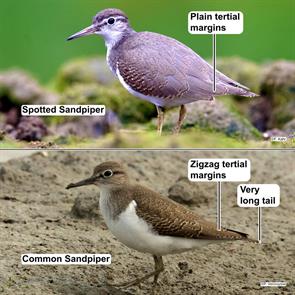
    Fig. 15. Comparison of Spotted Sandpiper with Common Sandpiper juveniles. Note longer tail, dark bill and grayish legs of Common Sandpiper. SPSA: Barnstable, MA. 24 July 2022. COSA: Zeeland, Netherlands. 18 August 2024.
In this guide, we cover the features, in order of importance, to look for on these birds. When discussing plumages, we use the terms winter, spring and summer to refer to temperate-zone northern hemisphere seasons. Because some of these birds spend parts of the year in the northern and southern hemispheres, the correct technical terms for the plumage stages—basic and alternate—help avoid the confusion of seasonal terminology. 
The photos in the album are arranged in this order:
Basic: winter plumage, roughly September to March.
Spotted Sandpiper begins its molt to winter (basic) plumage in the fall; full basic plumage is usually attained by October of the second year; see Fig. 1.
Alternate: first spring and summer after hatch year or adult breeding plumage, March to August.
Beginning in spring, winter (basic) feathers on Spotted Sandpiper are gradually replaced by alternate feathers; see Fig. 3.
Chick: newly hatched young, April to July.
Chick is downy, gray above and white below, and has a bold black eye line. See Fig. 10.
Juvenile: young bird, June to September.
Juvenile feathers are acquired immediately after the natal down is shed and before the young begin their southbound migration; see Fig. 12.
Spotted Sandpiper (Actitis macularius) (SPSA) is among the most widespread and familiar shorebirds in the Western Hemisphere. Its spotted breast and belly in spring (alternate) plumage, its constant teetering, the stiff wingbeats with which it propels itself along a river shore or lakeside, and the ringing peet-weet calls as it flushes make it an unmistakable presence along our (mostly inland) shores.
As with many shorebird species, the female Spotted Sandpiper initiates pair bonding and sets up the nesting territory. It nests on the ground, and the nest is notoriously difficult to find.

Size and weight

Females average slightly larger than males and have longer bills.
Body length:
7.1–7.9 in. (18–20 cm)
Wingspan:
14.6–15.8 in. (37–40 cm)
Bill length:
0.8–1.1 in. (19–29 mm)
Weight:
1–1.9 oz. (29–53 g)

Calls

Often, Spotted Sandpiper first announces its presence through characteristic high-pitched peet-weet calls. These are usually emitted when the bird flushes or flies low above the water.
Calls in Summit Lake, Shasta County, CA, 2019:
Calls in Hawk Rise, Sanctuary, Union County, NJ, 2019:

Plumage and other characteristics

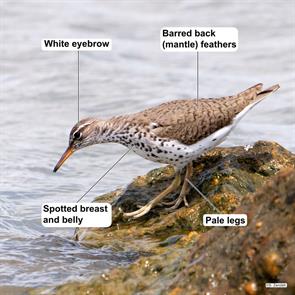
Spotted Sandpiper in breeding (alternate) plumage is nearly unmistakable due to its uniquely (for a shorebird) spotted breast and belly; see Fig. 3, Fig. 5, Fig. 6, Fig. 7, Fig. 8.

Spotted Sandpiper’s back (mantle) in spring and summer (alternate) plumage is brown with a jagged, dark brown crossbar on each feather; see Fig. 3, Fig. 4, Fig. 9.

Spotted Sandpiper flies with stiff, short wingbeats low above the surface of the water along the shore or from rock to rock while calling its characteristic peet-weet alarm.

Walking or standing, Spotted Sandpiper often teeters, bobbing its tail and rump, sometimes incessantly, for a long time.

In all plumages, a bold, pale, broken eye ring and pale eyebrow are characteristic of the bird; see Fig. 3, Fig. 9.

In all plumages, the back (mantle) is brown or grayish brown. The sides of the lower neck and upper breast are brown. A wedge of white separates the brown of the neck and breast from the brown of the folded wings; see Fig. 1, Fig. 11.

The legs are pale: yellow in winter, somewhat pink or orange in breeding plumage; see Fig. 1, Fig. 3, Fig. 8.

The bill is straight, short and two-toned. The base two-thirds is yellow or pinkish and the tip is dark; see Fig. 2.

In flight, the underwings show alternating dark and white bands; see Fig. 6.

The upper wings are gray with narrow, short wing stripes. There are often pale feathers at the front edge, the bend of the wing; see Fig. 5.

The tail projects slightly beyond the folded wings; see Fig. 2. It is gray brown with a dark and light zigzag margin; see Fig. 4.

Winter (basic) plumage is gray brown on the back (mantle). Each mantle feather displays a crisp, dark center shaft; see Fig. 1, Fig. 2.

Winter (basic) adult and juvenile have white underparts; see Fig. 1, Fig. 12.

Winter (basic) adult and juvenile have conspicuously barred wing coverts; the barring consists of dark-pale-dark parallel marks; See Fig. 1, Fig. 2, Fig. 12.

Juvenile back (mantle) feathers are brown with crisp central shafts and dark brown subterminal margins; see Fig. 12.

Breeding range, migration, wintering range, habitat

The breeding range of Spotted Sandpiper comprises nearly the entirety of North America north of Texas and other southeastern states. Nesters are also absent from the Canadian far northeastern coast and islands.
Similar to many other shorebird species, female Spotted Sandpipers initiate courtship. Female Spotted Sandpipers are polyandrous; a female may acquire a number of mates in succession. After laying eggs for one male, the female moves on, courts another, lays eggs in another nest and may repeat this up to 4 or 5 times.
The nest is constructed on the ground near water, such as a river or a pond, often in a heavily vegetated area; this helps to avoid ground predators of the nest, eggs and young.
Females do some incubation of eggs, but males generally spend most of the time incubating eggs and, later, brooding chicks.
Newly hatched young are precocial and chase down their own food, usually soft insects or other arthropods.
Winter range for Spotted Sandpiper covers the southernmost United States, Caribbean islands, most of Central America and northern and central South America. Some birds winter on the Chilean coast as far south as the southern tip of South America.
Winter habitat ranges widely from coastal areas, rivers and lagoons to higher elevation rain and cloud forests.
Most food throughout the year consists of adult and larval insects, other invertebrates and sometimes small fish.

Similar species

Spotted Sandpiper compared to Solitary Sandpiper

During migration seasons, Spotted Sandpiper (SPSA) and Solitary Sandpiper (SOSA) are sometimes found in similar habitats. These mostly nonflocking birds often turn up singly at streambanks, riverbanks or wetlands. Both stand or walk with a teeter, the Spotted far more so than the Solitary. Both emit high-pitched double or triple whistles when flushed. For a comparison image, see Fig. 14.

Note the following:

  • Spotted Sandpiper looks dumpy with compact dimensions. Solitary Sandpiper is slimmer, longer-necked and longer-legged.
  • Spotted Sandpiper flies low over water with short flicks of stiff wings between landing spots. Solitary, when flushed, quickly rises high and flies in a swooping swallow-like fashion with angled wings.
  • In breeding (alternate) plumage, Spotted Sandpiper has distinctive dark spots on gleaming white underparts. Solitary Sandpiper’s underparts are always white up to the breast.
  • In breeding (alternate) plumage, Spotted has a pinkish-orange bill with a dark tip. The color fades to a darker orange or brownish at other seasons. Solitary’s bill is dull grayish brown or greenish brown, usually paler at the base throughout the year.
  • Spotted’s back (mantle) is usually a solid gray brown (winter or basic), with darker brown bars (breeding or alternate) or with dark brown subterminal lines (juvenile). In all plumages, Solitary’s mantle is brown with distinctive pale or white spots.
  • Spotted eye ring is often broken; pale and dark lines from the bill extend backward to and behind the eye. Solitary Sandpiper has a bold eye ring and a pale line extending forward from the eye to the bill with a dark line below it.
  • In flight, Spotted’s tail is mostly brown with a pale zigzag margin. Solitary’s tail is dark at the center and boldly barred on the edges.
  • Spotted Sandpiper in flight has thin white stripes on the upper wings. The underwings have alternate pale and dark lines. In flight, Solitary has brown wings above with no pale stripes and dark gray-brown wings below with some barring.

Spotted Sandpiper compared to Common Sandpiper

Spotted Sandpiper (SPSA) and Common Sandpiper (COSA) are sister species that are nearly identical in all but breeding (alternate) plumage. Common Sandpiper is common in palearctic regions of Europe and Asia but would be extremely unusual in New England. Spotted Sandpiper, which is widespread throughout the Western Hemisphere, on the other hand, is often reported in the United Kingdom and the rest of Europe.

Note the following:

  • Spotted Sandpiper is heavily and conspicuously spotted on the breast and belly during breeding season (alternate plumage), whereas Common Sandpiper is white on the belly and lower breast, sometimes showing faint dark streaks on the neck or breast.
  • Juvenile birds are the most likely to be vagrants; see Fig. 15 for a comparison image of juveniles.
  • In all plumages, Common Sandpiper has a longer tail than Spotted.
  • Spotted Sandpiper’s bill and legs are usually pale throughout the year. Common Sandpiper’s bill and legs become dusky in fall and winter.
  • Spotted has tertial feathers (feathers that cover the primaries when the wings are folded) with plain margins. Common Sandpiper’s tertials have dark-and-light narrow zigzag margins.
  • In winter (basic) and juvenile plumage, Common Sandpiper’s facial markings are more subdued than Spotted’s. The eyebrow line (supercilium) is much lighter and more conspicuous and the lower face much paler in Spotted.
  • Spotted and Common Sandpiper calls are distinctive. Spotted typically gives a peet-weet or peet-weet-weet call; Common’s calls are much higher pitched, sometimes a continuous series of buzzy, almost raspy, sounds.
  • In flight, Common Sandpiper’s white upper wing stripe is thicker and longer, spanning nearly the entire wing. Spotted Sandpiper’s wing stripe is thin and ends short of the body; see Fig. 5, Fig. 13.

© Copyright 2026 Bird Observer, Inc. and Eric Swanzey.
Website code/design/development by Swanzey Internet Group LLC.
Supporting photography by Just Your Nature.
Privacy Policy | Terms of Use